Duty mark (sovereign’s head)
The sovereign’s head in a British hallmark, showing that duty was paid on the piece between 1784 and 1890.
How to read it
Chaffers dates the duty mark, the head of the reigning sovereign, to 1784, when it began to show that the new duty on plate had been paid, and records that it was discontinued in 1890, when the duty was abolished. Jackson gives the exact span: gold and silver plate assayed in England and Scotland from 1 December 1784 to 30 April 1890 should carry it, apart from exempted articles. Birmingham Assay Office’s timeline gives the duty that came in with it as 6d an ounce on silver and 8 shillings an ounce on gold. Jackson lists the sovereign’s head as the last of the marks found on London plate.
Also searched as: king’s head hallmark, queen’s head hallmark, sovereign’s head mark.
A stamp is a claim about the metal, made by whoever struck it. This page says what each mark means under the rules that define it; it doesn’t test or value anything.
Dating a piece by the duty mark
Because the mark was used only between 1784 and 1890, it narrows the date of any piece that carries it, before the date letter is read. Chaffers uses it that way himself, to separate two London alphabets that look alike: the earlier one has no duty mark before 1784.
Which way the head faces
The head helps narrow the date further. Jackson writes that the heads of George III, George IV and William IV all look to the right and Queen Victoria’s looks to the left. Chaffers adds that George IV faces right on the silver mark though he faces left on his coins. For the first year and a half, from December 1784 to May 1786, Jackson says George III’s head was struck sunk into the metal (incuse) rather than raised, in an oblong stamp with the corners clipped; from 1786 the stamp was oval.
Why many jewels have no duty mark
The 1784 Act did not extend to jewellers’ work, which Chaffers’s abstract defines as gold or silver in which jewels or other stones are set, other than mourning rings. The Silver Society adds that watch cases were exempt from duty from 1798, so duty marks are not found in watch cases after that. Chaffers also notes that the lower gold standards of 15, 12 and 9 carat, legal from 1854, paid the duty but were not given the sovereign’s head.
An incuse Britannia
The same Act called for plate sent for export, on which the duty was refunded (the drawback), to be stamped with a figure of Britannia struck incuse, to tell it apart from the Britannia mark on the higher silver standard. Chaffers says makers objected to the number of stamps, and the drawback mark was in use for only about seven months, until July 1785.
Royal heads that are not duty marks
A sovereign’s head on 20th-century or later silver is a different mark. Birmingham Assay Office records the first commemorative voluntary mark in 1934, for the silver jubilee of George V and Queen Mary, and the Goldsmiths’ Company Assay Office lists commemorative marks for the Silver Jubilee of 1935, the Coronation of 1953, the Jubilees of 1977, 2002 and 2012 and the Millennium in 2000. The two offices give different years for the first of them.
The end of the duty
Chaffers writes in his introduction that the duty on both gold and silver articles was abolished in 1890, and that the sovereign’s head consequently ceased to be impressed; Birmingham’s timeline says the same. His table of statutes records the 1815 duty act as repealed as regards silver plate in 1890.
Forging the mark, and the rates
Jackson notes that forging the duty mark was made a capital felony punishable with death. He also records the rates rising: under an Act of 1796–7 the duty on gold stayed at eight shillings an ounce while the duty on silver plate went up to one shilling. Chaffers’s table of statutes gives a later rate of 17 shillings an ounce on gold and 1s. 6d. on silver, set in 1815.
Real examples
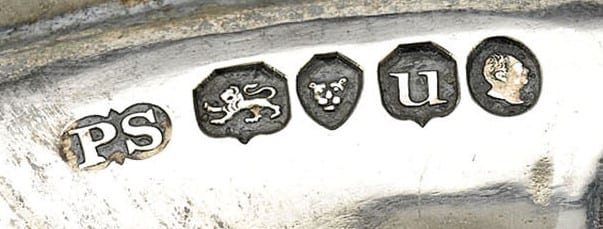
Head of William IV, the duty mark, last in a row of London marks on a silver tray by Paul Storr, 1835Photo: Rauantiques, CC BY-SA 4.0, via Wikimedia Commons 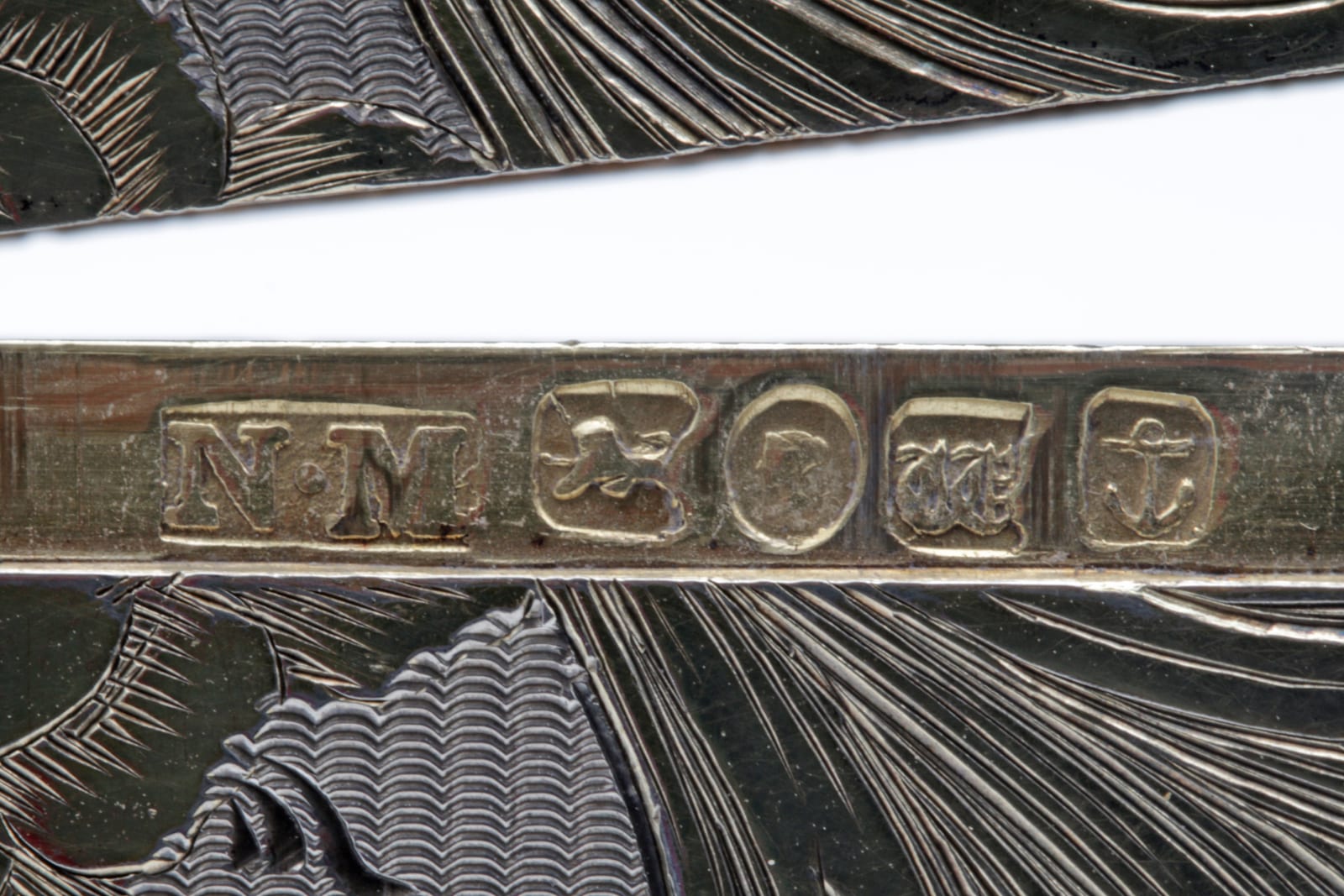
Head of Queen Victoria, the duty mark, in a row of Birmingham marks on silver by Nathaniel Mills, 1845Photo: Charles J. Sharp, CC BY-SA 4.0, via Wikimedia Commons


More jewelry marks
Browse symbols drawn with circles or curves and waves.
Sources
- Hall Marks on Gold & Silver Plate (Chaffers, 1922), William Chaffers, Hall Marks on Gold & Silver Plate, 1922 edition, Internet Archive (scan), Duty mark; Introduction; Duty, 1784; Table of statutes; Table of statutes, 1815
- English Goldsmiths and Their Marks (Jackson, 1905), Charles James Jackson, English Goldsmiths and Their Marks, 1905, Internet Archive (Cornell University Library scan), Marks on London plate; The sovereign’s head; The duty
- Our Story (Birmingham Assay Office), Our Story: timeline, 1773–2009, Birmingham Assay Office, 1784; 1890; 1934
- Identify Your Silver (The Silver Society), Identify Your Silver: an introduction to British hallmarks, The Silver Society, Duty mark
- What is a Hallmark? (Goldsmiths’ Company Assay Office), What is a Hallmark?, The Goldsmiths’ Company Assay Office, London, Commemorative Marks
Last reviewed September 29, 2026 by Rory Hansen. How we research