925 (sterling silver)
The metal is sterling silver: at least 925 parts in every 1,000 are pure silver.
Easily confused with
- EPNS (electroplated nickel silver)Electroplated nickel silver: a base of nickel silver, an alloy of copper, nickel and zinc, coated with a thin layer of silver by electroplating. It is not solid silver.
- Nickel silver (German silver)Nickel silver, also called German silver, is an alloy of copper, nickel and zinc. It looks like silver but contains no silver; it is the usual base under silver plate, and the NS in EPNS.
How to read it
In the US, the FTC’s jewelry guides say the words sterling silver, sterling or the abbreviation Ster. belong only on metal that is at least 925/1,000ths pure silver, and the same goes for the words solid silver. The National Gold and Silver Stamping Act sets the same figure for anything marked sterling. The UK’s Hallmarking Act reads the word the same way, as a standard of fineness of 925, and 925 is one of the four silver standards it lists for hallmarking. The Silver Society gives the older way of saying it: not less than eleven ounces and two pennyweights of pure silver in the pound troy.
Also searched as: 925, 925 silver, S925, Ster., sterling.
A stamp is a claim about the metal, made by whoever struck it. This page says what each mark means under the rules that define it; it doesn’t test or value anything.
Is 925 the same as sterling silver?
Yes. The figures and the word stand for the same standard in both countries’ rules: 925 parts per thousand of pure silver. The FTC’s consumer guide says the words silver, sterling and sterling silver describe products that contain 92.5% pure silver, and that silver marked 925 is 925 parts per thousand pure silver.
925, .925 and 92.5
These are the same proportion written three ways: parts per thousand, a decimal and a percentage. The decimal form has its own history in Britain. The Silver Society records that from 1904, imported silver hallmarked at a British assay office did not get the lion passant or the leopard’s head; its fineness was struck as the decimal .925 in an oval shield instead (.9584 for Britannia silver).
How close to 925 the silver has to be
The two countries measure the claim differently. The US Stamping Act allows a divergence of four parts per thousand for silver marked sterling or coin, and when the whole article is assayed as one piece, solder included, the silver may fall short of the marked fineness by no more than ten parts per thousand. The FTC’s guides repeat those tolerances. A British hallmark allows no shortfall: the Goldsmiths’ Company Assay Office says the quality of the whole article is no less than the fineness indicated.
Who stands behind a US 925 mark
In the US the mark is the maker’s or importer’s own claim. Nobody from the government tests it, and the Stamping Act makes it unlawful to stamp gold or silver with the words “United States assay” or anything calculated to give the impression that the United States Government has certified its fineness. Since 1961 the Act has required whoever applies a quality mark such as 925 to apply their name, or a trademark registered or applied for, by the same means as the quality mark, in lettering at least as large and as close to it as possible. A manufacturer or dealer who knowingly breaks these rules commits a misdemeanor, and competitors, customers and later buyers of the piece can sue for an injunction and damages. The FTC’s guides say they do not confer any rights on any person.
925 in a British hallmark
In a UK hallmark the figures 925 sit in a shield whose outline shows the metal, beside the sponsor’s mark and the assay office mark. The lion passant (a lion rampant at Edinburgh) is an optional extra: Sheffield Assay Office records that the sterling lion became optional in January 1999. Articles under 7.78 grams are exempt from hallmarking, and the assay offices’ guidance notes mention a plain 925 stamp on underweight articles.
925 or coin silver?
Coin silver is a lower standard: the FTC’s guides and the Stamping Act keep the words coin and coin silver for metal of at least 900 parts pure silver. The Stamping Act also bars the word sterling, alone or with other words, from silver-plated goods.
925 or Britannia silver?
Britannia silver is higher, at 958.4. The Silver Society says it was introduced in 1697 to stop silver wares being made from melted coins, and was the only legal standard for silver wares until 1720, when sterling was allowed again. Both remain legal in the UK.
Gold on 925 silver
Under the UK assay offices’ guidance, gold-plated silver is hallmarked as silver, and no standalone gold fineness mark is allowed on it. In the FTC’s guides, vermeil is a sterling silver base plated with gold of at least 10 karat, 2.5 microns thick. They also list “14K/Sterling” as a misleading description of a piece that contains more silver than gold.
Real examples
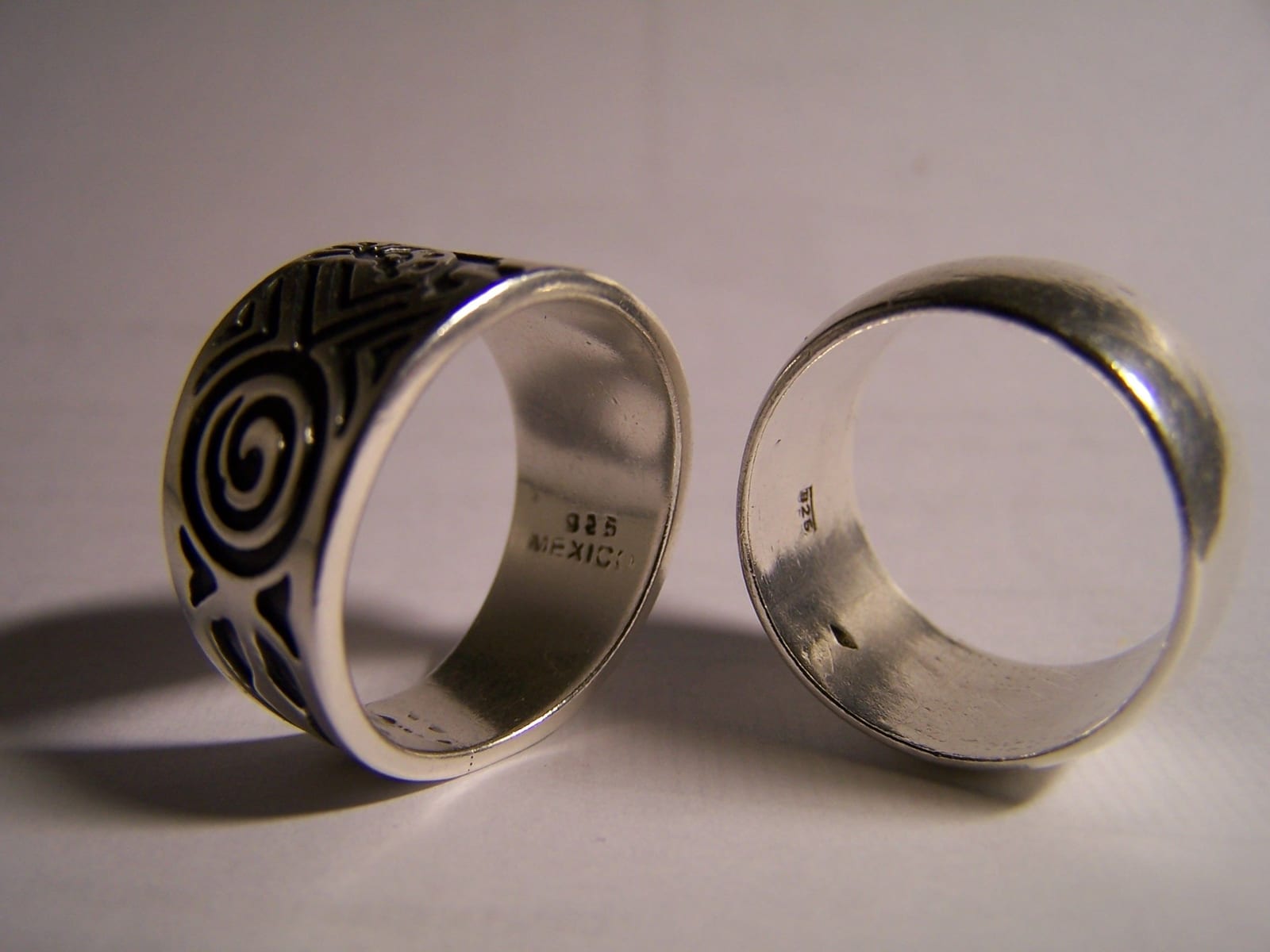
925 and MEXICO stamped inside two silver ring bandsPhoto: Magnus Colossus, CC BY 2.5, via Wikimedia Commons 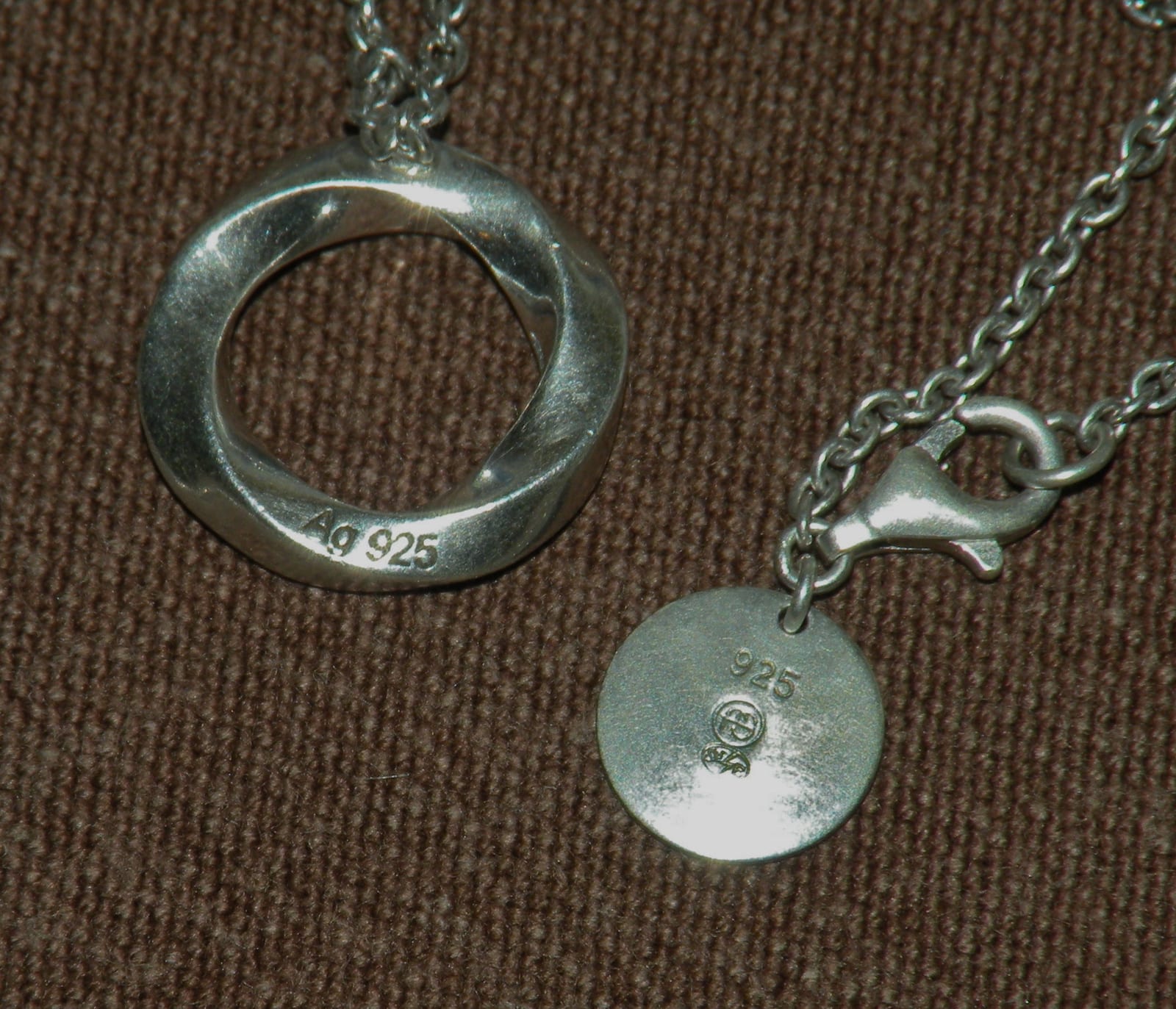
AG 925 stamped on a silver pendant, and 925 on the tag by the clasp of its chainPhoto: Chatsam, CC BY-SA 3.0, via Wikimedia Commons 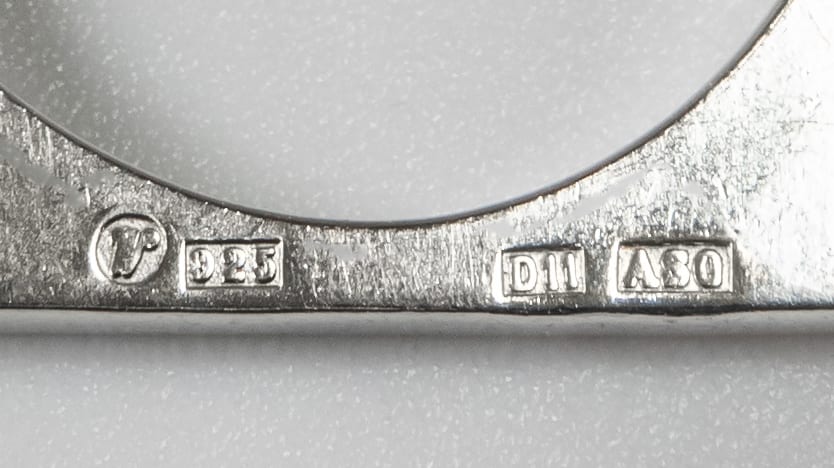
925 stamped on the inside of a Swedish silver ring, beside the maker's mark and other Swedish hallmarksPhoto: W.carter, CC BY 4.0, via Wikimedia Commons


Read next
- Next in Jewelry marks999 (fine silver)The metal is fine silver: 999 parts in every 1,000 are pure silver.
- The same shape in AI labels and iconsAI iconAI-generated or AI-changed content. A badge with the letters AI, often in a circle or beside a word such as generated or modified, labels an image, video, sound or text as made or altered with artificial intelligence. The European Union publishes an official set of these icons.
More jewelry marks
The same shape elsewhere
Browse symbols drawn with circles or letters and numbers.
Sources
- Guides for the Jewelry, Precious Metals, and Pewter Industries (16 CFR Part 23), 16 CFR Part 23 (1 January 2021 edition), Federal Trade Commission, published by the U.S. Government Publishing Office, § 23.5(b)(2); § 23.5(c) n. 35; § 23.0(d); § 23.4(b); § 23.8(b)(2)
- Falsely Stamped Gold or Silver or Goods Manufactured Therefrom (15 U.S.C. chapter 8), 15 U.S.C. 291–300, the National Gold and Silver Stamping Act (2021 edition), U.S. Government Publishing Office, §§ 291, 296, 297, 298
- Hallmarking Act 1973, Schedule 1, Hallmarking Act 1973 (c. 43), Sch. 1, Pt. III, legislation.gov.uk (The National Archives), Sch. 1, Pt. III, para. 3(2)
- Hallmarking Act 1973, Schedule 2: Approved Hallmarks, Hallmarking Act 1973 (c. 43), Sch. 2, legislation.gov.uk (The National Archives), Sch. 2, Pt. I, para. 2
- Buying Platinum, Gold, and Silver Jewelry (FTC Consumer Advice), Buying Platinum, Gold, and Silver Jewelry, November 2024, Federal Trade Commission, Silver Jewelry
- Identify Your Silver (The Silver Society), Identify Your Silver: an introduction to British hallmarks, The Silver Society, The standard mark; Britannia standard; imported silver
- What is a Hallmark? (Goldsmiths’ Company Assay Office), What is a Hallmark?, The Goldsmiths’ Company Assay Office, London, Millesimal Fineness Mark
- A Detailed History of Sheffield Assay Office, A Detailed History of Sheffield Assay Office, Sheffield Assay Office, 1999
- Hallmarking Guidance Notes (UK Assay Offices, 2022), Hallmarking Guidance Notes: practical guidance in relation to the Hallmarking Act 1973, November 2022, The UK Assay Offices, published by the British Hallmarking Council on GOV.UK, pp. 2, 5, 11
Researched, edited and approved by Rory Hansen before publishing. Last reviewed September 29, 2026. How we research
Added . Last updated .