Date letter (hallmark)
A letter in a British hallmark that shows the year the piece was marked.
How to read it
The UK’s Hallmarking Act makes the date letter optional today: a letter of the alphabet, changed each year, to denote the year in which the article is marked. The UK assay offices say it was compulsory until 1999, and that it now changes on 1 January each year. Chaffers dates the date letter at the London Assay Office to 1478; each alphabet ran from A to U or V, leaving out J, W, X, Y and Z. The Goldsmiths’ Company links it to a statute of Edward IV of that year, which made the Company responsible for wares found below standard.
Also searched as: hallmark date letter, year letter.
A stamp is a claim about the metal, made by whoever struck it. This page says what each mark means under the rules that define it; it doesn’t test or value anything.
Reading the year
The same letter comes round again in a later alphabet, told apart by the style of the letter and the shape of its shield. The Goldsmiths’ Company Assay Office says the font, the case and the shield shape all change, so that each letter can indicate only one year, and that all the date punches are destroyed at the end of the year. The British Hallmarking Council gives U as the letter for 2019.
Why a letter at all
The Goldsmiths’ Company’s history says that after the 1478 statute its wardens reorganised assaying at Goldsmiths’ Hall, introduced the date letter, and required workers to bring their wares to the Hall to receive the hallmark. Chaffers calls it the assayer’s mark. The Silver Society says it was first meant to show who had been the assayer when a piece was tested.
A letter can span two years
Before 1975 the letter did not change on 1 January. Chaffers writes that in London before the Restoration it changed on St Dunstan’s Day, 19 May, when the new wardens were elected, and that from 1660 the assay year began on 30 May. The Silver Society points out that each assay office had its own sequence of letters and changed them on its own date, so an old letter usually covers parts of two calendar years, written as 1895/6. Since the 1973 Act, according to Sheffield and Birmingham, all the offices have used the same letter and alphabet, changing on 1 January.
Letters that look alike
Chaffers gives an example of two London cycles that are hard to tell apart: cycles 14 and 16 are both small Roman letters in similar shields, covering 1776 to 1795 and 1816 to 1835. He sorts them by the other marks: the duty mark appears from 1784, and the leopard’s head lost its crown in the 1820s.
Optional since 1999
The 1998 amendment regulations, in force on 1 January 1999, made the date letter one of the marks an assay office strikes only when the person submitting the piece asks for it, and said its absence does not make the article unhallmarked. The Goldsmiths’ Company Assay Office still applies it as part of its standard hallmark. A modern piece without a date letter can be fully hallmarked.
Date letters and the lion
From 1560, Chaffers writes, the London letter sat in a heraldic shield rather than an outline following the letter. The lion passant and the other marks beside it changed shape at different times, which is why tables of marks show them alongside each cycle of letters.
Who chooses the letter
The Hallmarking Act leaves the letter to the British Hallmarking Council: the date letter is such distinct letter as the Council directs in writing. Before 1975 each office chose for itself. Chaffers writes that at Birmingham the letter changed with the annual election of wardens, and the custom was to take the letters in alphabetical order.
Real examples
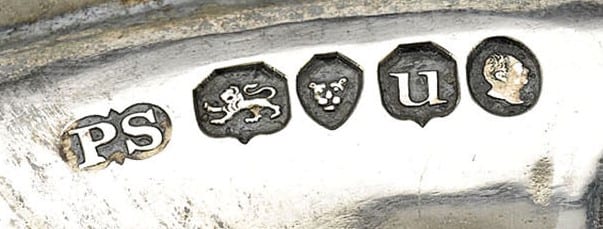
Date letter u for 1835, fourth in a row of London marks on a silver tray by Paul StorrPhoto: Rauantiques, CC BY-SA 4.0, via Wikimedia Commons 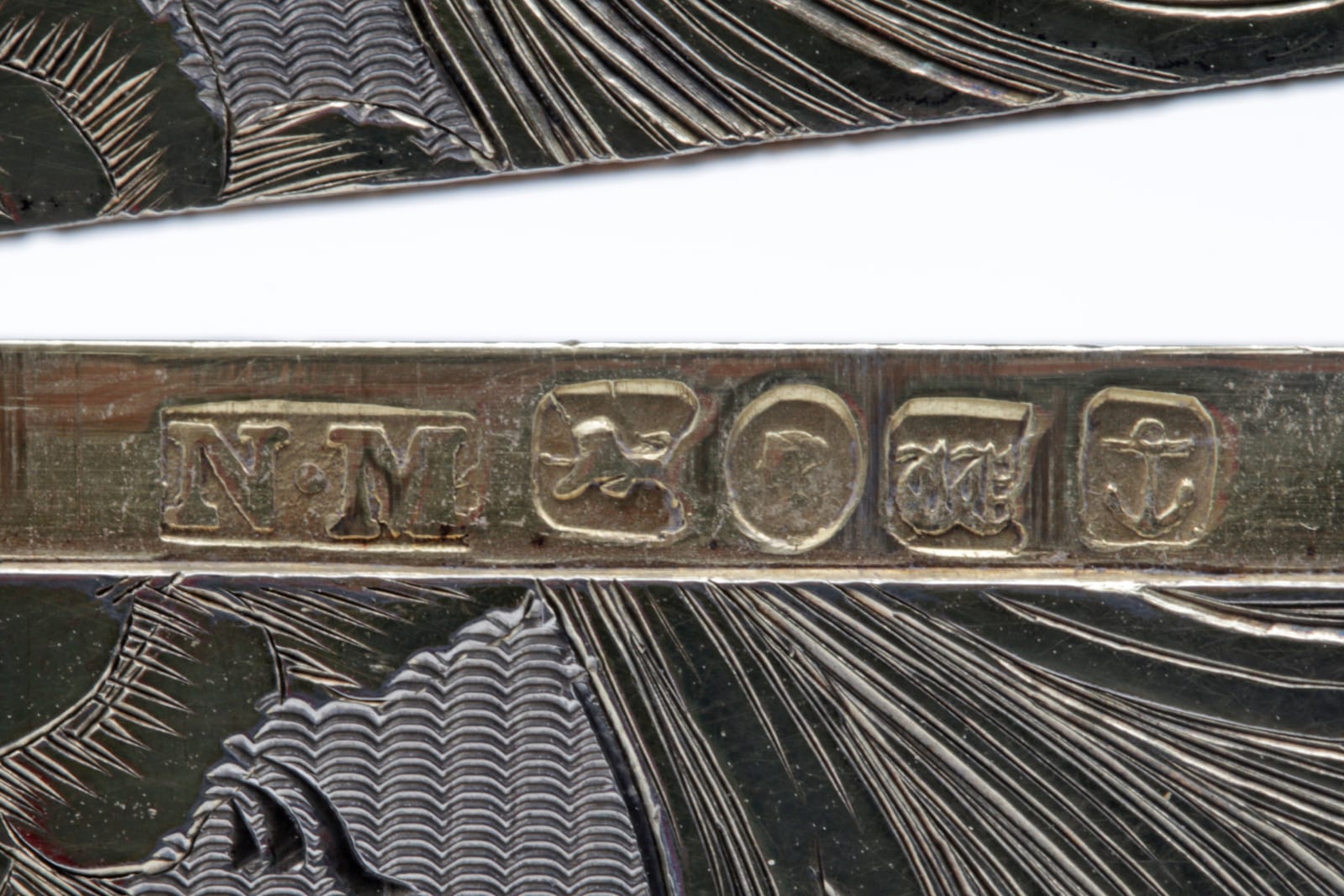
Date letter for 1845 beside the anchor on silver by Nathaniel Mills, BirminghamPhoto: Charles J. Sharp, CC BY-SA 4.0, via Wikimedia Commons 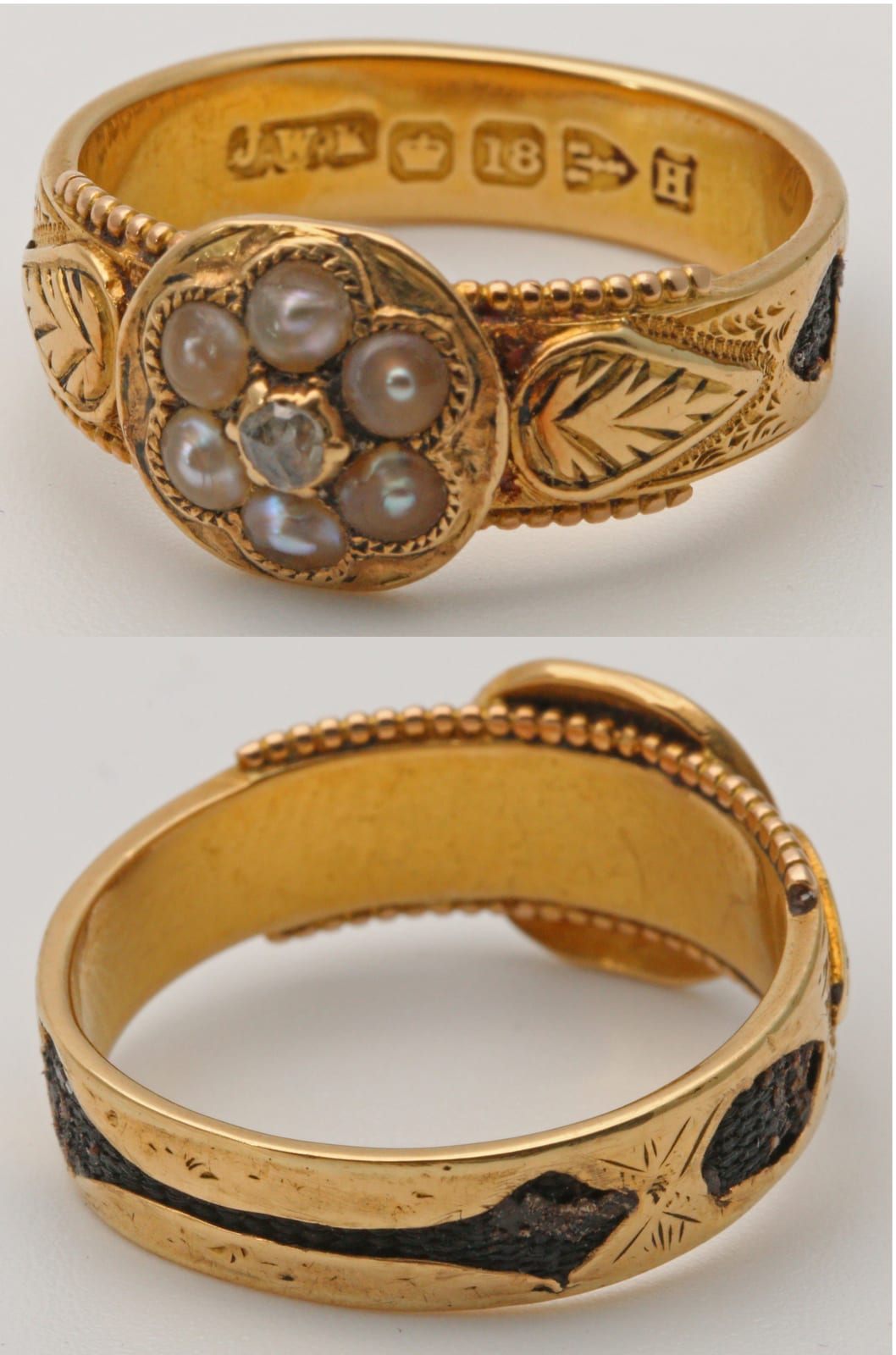
Date letter H for 1891, last in the row of marks inside a Chester-hallmarked gold ringPhoto: Charles J. Sharp, CC BY-SA 4.0, via Wikimedia Commons 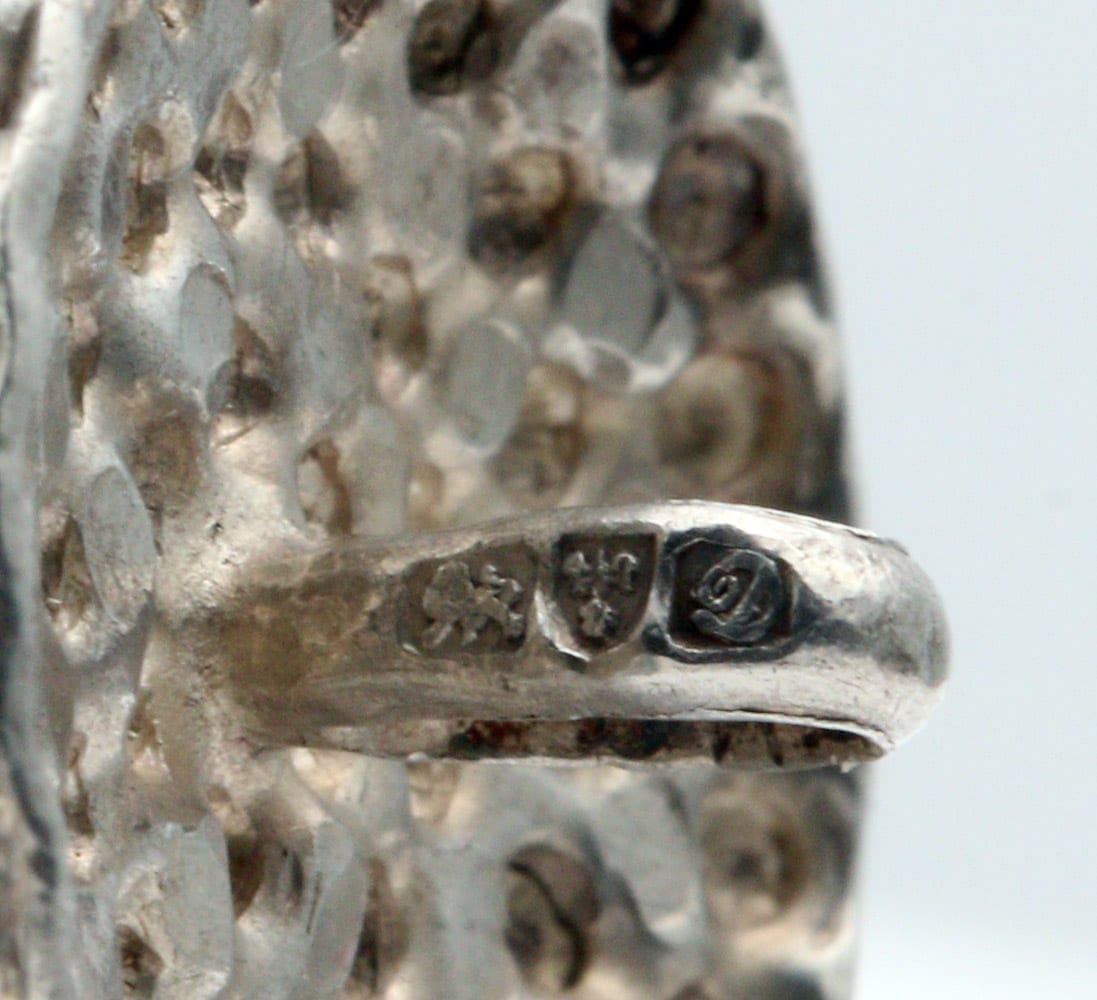
Date letter for 1904 after the lion passant and the Chester mark, on a silver button by Charles HornerPhoto: Charles J. Sharp, CC BY-SA 4.0, via Wikimedia Commons


Read next
- Next in Jewelry marksMaker’s markThe mark of the maker, or of whoever sent the piece for hallmarking, usually their initials.
- The same shape in NFPA 704 fire diamondFlammability rating (red)The red section at the top of the NFPA 704 fire diamond. Its number, 0 to 4, rates how easily the material catches fire: 0 will not burn, 4 vaporizes readily at normal temperatures and burns readily.
More jewelry marks
The same shape elsewhere
Browse symbols drawn with letters and numbers.
Sources
- Hallmarking Act 1973, Schedule 2: Approved Hallmarks, Hallmarking Act 1973 (c. 43), Sch. 2, legislation.gov.uk (The National Archives), Sch. 2, Pt. I, para. 4
- Hall Marks on Gold & Silver Plate (Chaffers, 1922), William Chaffers, Hall Marks on Gold & Silver Plate, 1922 edition, Internet Archive (scan), III. Date mark; The standard mark; Birmingham
- The Goldsmiths’ Company: history, History of the Goldsmiths’ Company, The Goldsmiths’ Company, 1478
- What is a Hallmark? (Goldsmiths’ Company Assay Office), What is a Hallmark?, The Goldsmiths’ Company Assay Office, London, Date Letter Mark
- Identify Your Silver (The Silver Society), Identify Your Silver: an introduction to British hallmarks, The Silver Society, Date letter
- Hallmarking Guidance Notes (UK Assay Offices, 2022), Hallmarking Guidance Notes: practical guidance in relation to the Hallmarking Act 1973, November 2022, The UK Assay Offices, published by the British Hallmarking Council on GOV.UK, p. 6
- Hallmarking is the law: guidance summary (British Hallmarking Council), Hallmarking: practical guidance, summary, British Hallmarking Council, GOV.UK, Optional marks
- A Detailed History of Sheffield Assay Office, A Detailed History of Sheffield Assay Office, Sheffield Assay Office, Hallmarking Act 1973
- Our Story (Birmingham Assay Office), Our Story: timeline, 1773–2009, Birmingham Assay Office, 1975
- The Hallmarking (Hallmarking Act Amendment) Regulations 1998, S.I. 1998/2978, as made, legislation.gov.uk (The National Archives), reg. 2(8)
Researched, edited and approved by Rory Hansen before publishing. Last reviewed September 29, 2026. How we research
Added . Last updated .