Maker’s mark
The mark of the maker, or of whoever sent the piece for hallmarking, usually their initials.
How to read it
Every master goldsmith has had to have a mark of his own since a statute of 1363, which Chaffers and Jackson both date as the first law to mention one; the Goldsmiths’ Company dates it to the same year. In a British hallmark it sits alongside the assay office’s mark and the standard mark. Today it is called the sponsor’s mark and is one of the three compulsory marks: in the UK it has at least two letters within a surround, and it is registered with an assay office.
Also searched as: maker’s mark hallmark, silversmith’s mark, sponsor’s mark.
A stamp is a claim about the metal, made by whoever struck it. This page says what each mark means under the rules that define it; it doesn’t test or value anything.
Maker’s mark or sponsor’s mark?
The two names are for the same mark, and the modern one is more accurate. The Goldsmiths’ Company Assay Office says the purpose of the mark is to establish responsibility rather than identify the manufacturer, as it has been from the start, and that it can be applied to items made by others. The Silver Society gives an example: the 18th-century silversmith Paul de Lamerie subcontracted work to other workshops but struck the finished pieces with his own punch. The person submitting an item took responsibility for the fineness of the metal and bore the penalty if it was found substandard, which is why sponsor’s mark is now the term. The British Hallmarking Council lists manufacturers, wholesalers, retailers and importers among those who can be sponsors.
From symbols to initials
Chaffers writes that the earliest workers almost invariably used a symbol or emblem, such as an animal, fish, crown, star or rose. Under the Act of 1697–8, makers used the first two letters of their surname instead of their initials; after that Act was repealed in 1720 many went back to their former marks, and a statute of 1739 required new punches with the initials of the Christian name and surname. The London office says a sponsor’s mark today has a minimum of two and a maximum of five initials inside a shield whose shape varies.
Who may register one
In 1725, the Goldsmiths’ Company’s history records, the Attorney-General established that the right to enter a maker’s mark at Goldsmiths’ Hall could not be denied to anyone, whether or not he was free of the Company. The ruling followed complaints about Huguenot goldsmiths who had been having London craftsmen present their work as if it were their own.
Logos as sponsor’s marks
The UK assay offices’ guidance notes set out what a sponsor’s mark may look like. A logo must contain at least two letters, or sit inside an approved assay office surround if it is a symbol only; numbers alone are not approved; nor is any design resembling a current or ancient hallmark; and designs of more than five characters are unlikely to make a satisfactory punch.
The US counterpart: a trademark beside the quality mark
In the US, the Stamping Act requires whoever applies a gold or silver quality mark to apply their name or a trademark, registered or applied for, by the same means, in lettering at least as large and as close to the quality mark as possible. The FTC’s guides restate the rule. The difference is what stands behind it: the US mark is the maker’s own claim, while a UK sponsor’s mark is struck on work that an assay office then tests.
Responsibility marks abroad
Under the International Hallmarking Convention the same mark is called the responsibility mark, also called the sponsor’s mark in some countries. It has to be registered in the country that applies the Common Control Mark, not in the importing country.
Registers of marks
Chaffers quotes the early wording: in 1379 every goldsmith was to have his own proper mark upon the work, and in 1433 it was the mark or sign of the worker. A Goldsmiths’ Company order of 1675 required plate workers to strike their marks on a table kept in the Assay Office and enter their names and addresses in a book, so that makers and marks could be matched.
Real examples
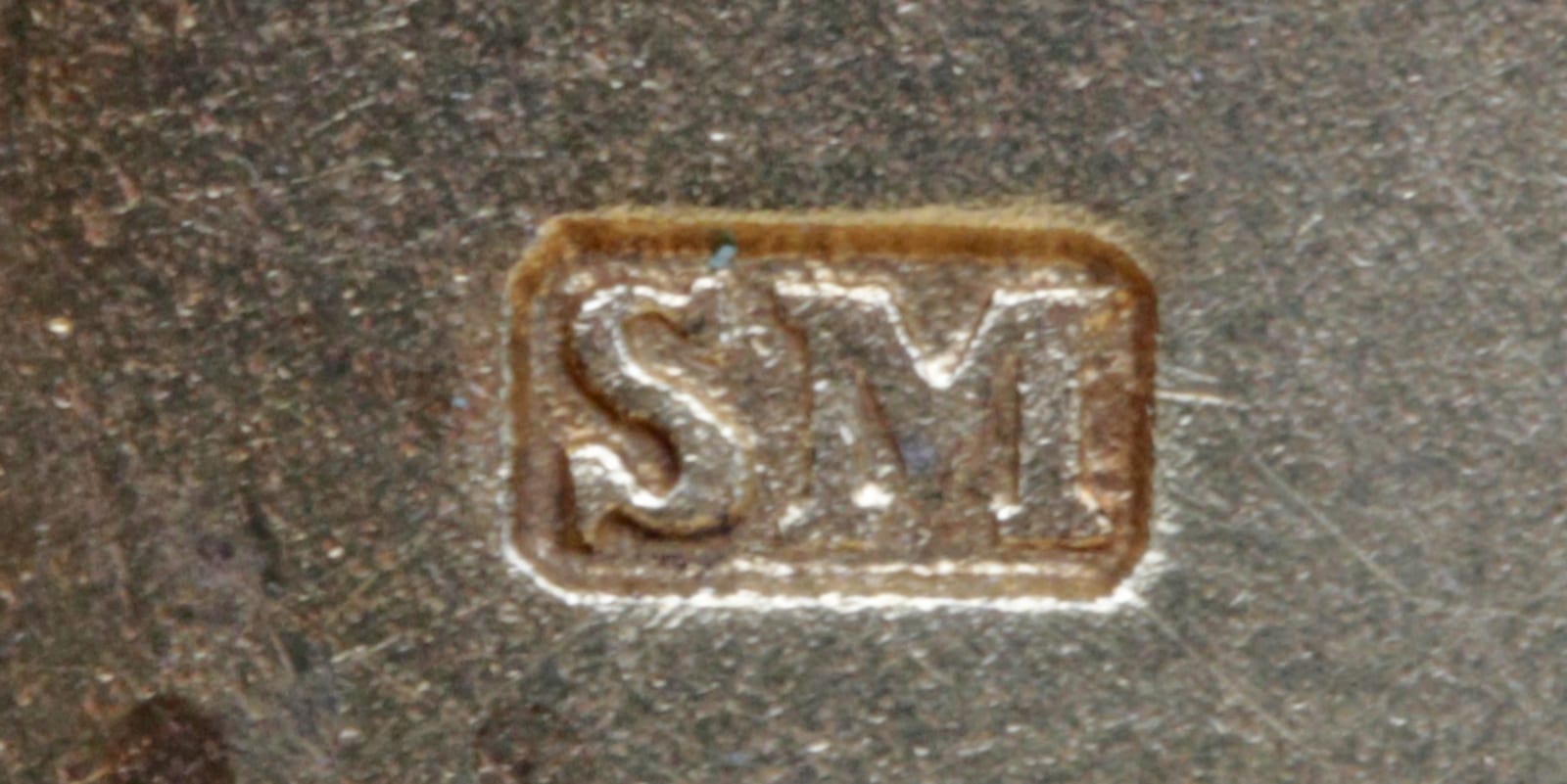
Maker's mark SM in a rectangle, registered by Sampson Mordan in 1823, stamped on silverPhoto: Charles J. Sharp, CC BY-SA 4.0, via Wikimedia Commons 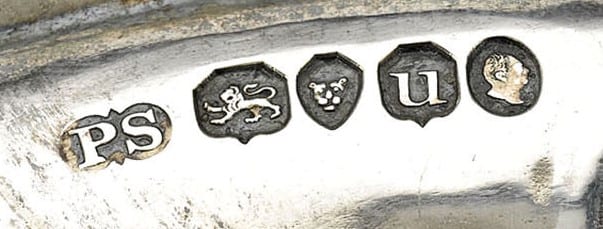
Maker's mark PS for Paul Storr, first in a row of London marks on a silver tray, 1835Photo: Rauantiques, CC BY-SA 4.0, via Wikimedia Commons 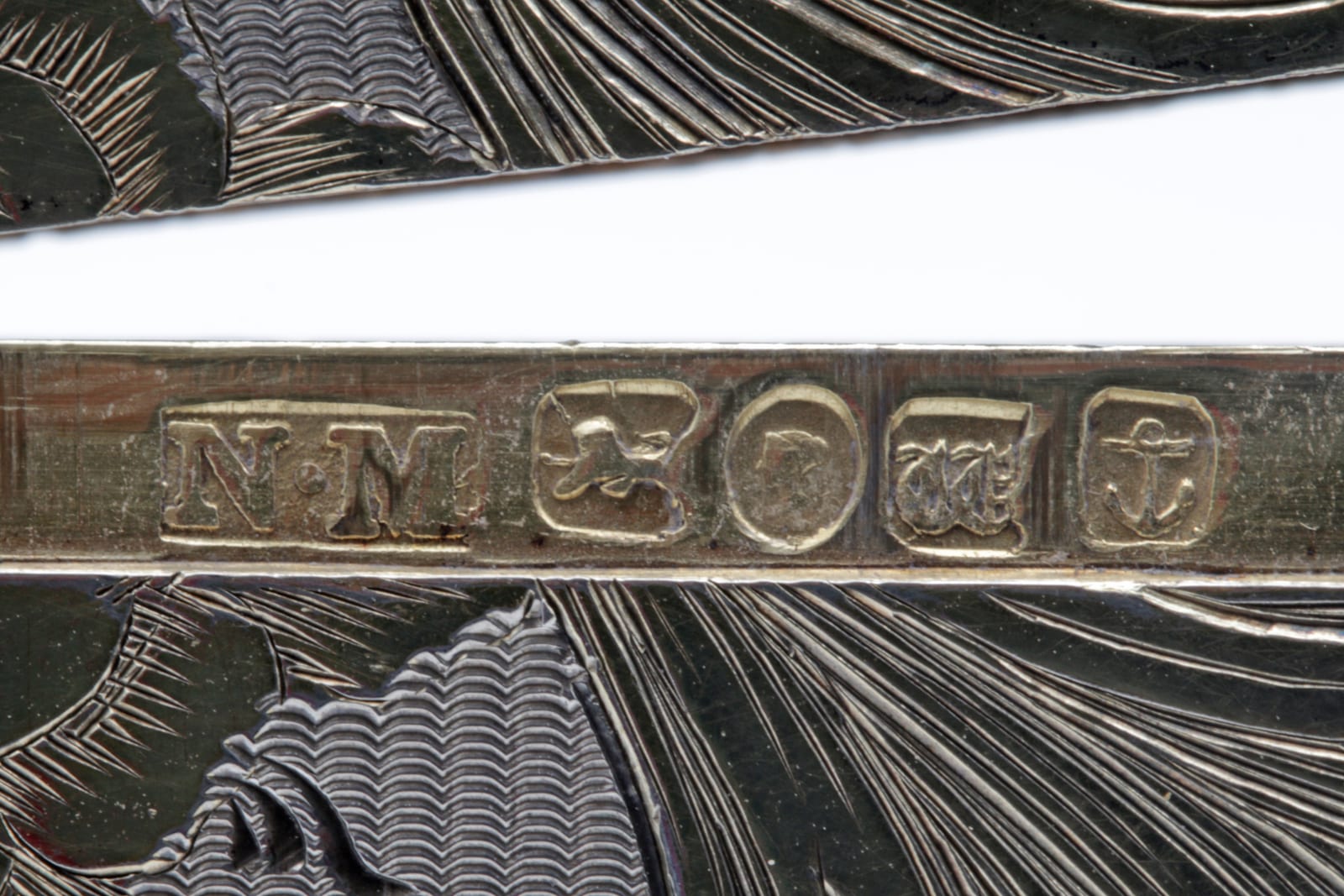
Maker's mark NM for Nathaniel Mills, first in a row of Birmingham marks, 1845Photo: Charles J. Sharp, CC BY-SA 4.0, via Wikimedia Commons 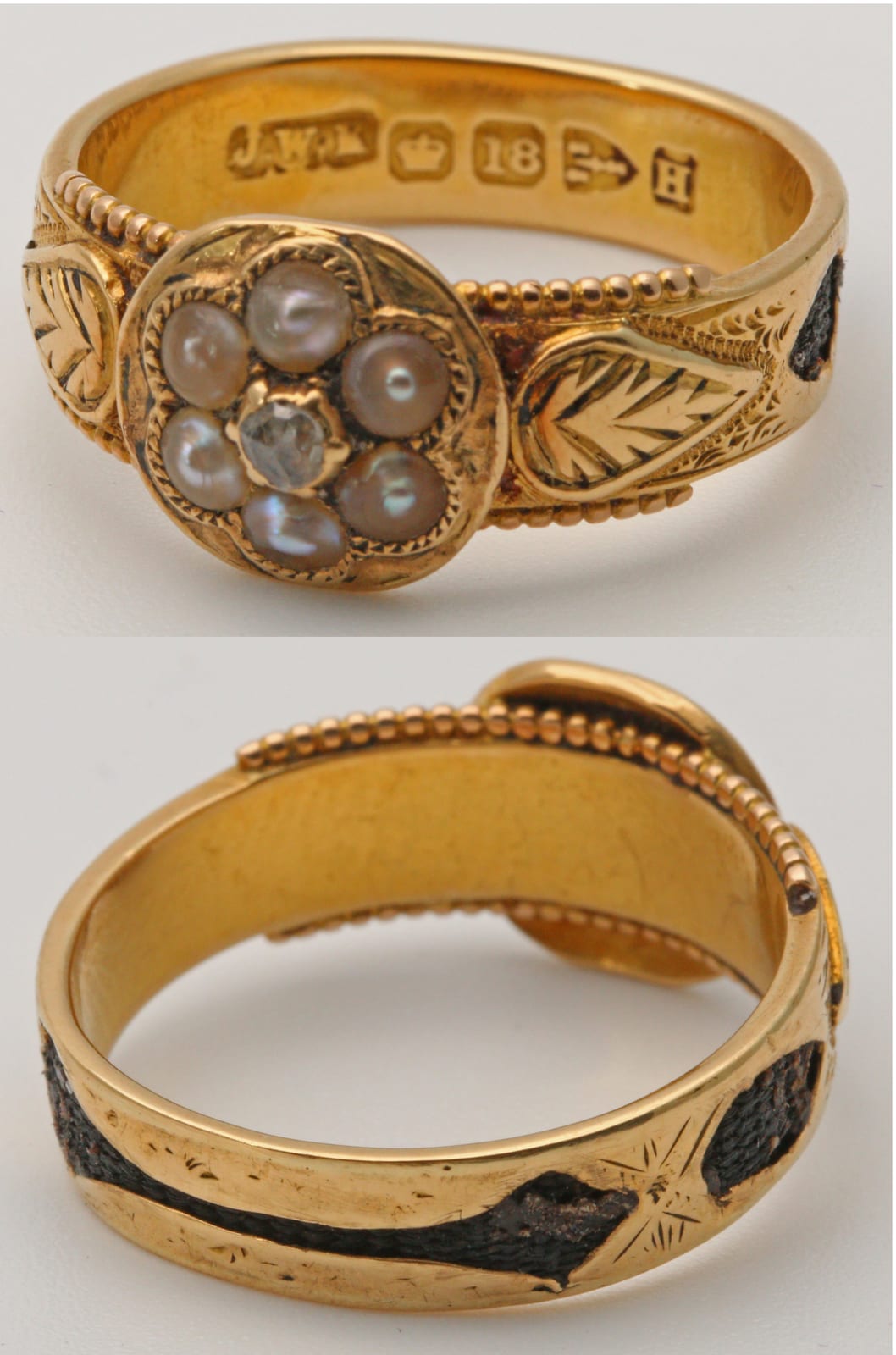
Maker's initials stamped first in the row of marks inside an 18-carat gold ring, Chester 1891Photo: Charles J. Sharp, CC BY-SA 4.0, via Wikimedia Commons


More jewelry marks
Browse symbols drawn with letters and numbers.
Sources
- Hall Marks on Gold & Silver Plate (Chaffers, 1922), William Chaffers, Hall Marks on Gold & Silver Plate, 1922 edition, Internet Archive (scan), Statute of 1363; The maker’s mark; The maker’s mark
- English Goldsmiths and Their Marks (Jackson, 1905), Charles James Jackson, English Goldsmiths and Their Marks, 1905, Internet Archive (Cornell University Library scan), Act of 1363
- The Goldsmiths’ Company: history, History of the Goldsmiths’ Company, The Goldsmiths’ Company, 1363; Huguenot goldsmiths
- What is a Hallmark? (Goldsmiths’ Company Assay Office), What is a Hallmark?, The Goldsmiths’ Company Assay Office, London, Sponsor’s Mark
- Identify Your Silver (The Silver Society), Identify Your Silver: an introduction to British hallmarks, The Silver Society, Maker’s mark
- Hallmarking Guidance Notes (UK Assay Offices, 2022), Hallmarking Guidance Notes: practical guidance in relation to the Hallmarking Act 1973, November 2022, The UK Assay Offices, published by the British Hallmarking Council on GOV.UK, pp. 4, 8
- Hallmarking is the law: guidance summary (British Hallmarking Council), Hallmarking: practical guidance, summary, British Hallmarking Council, GOV.UK, Sponsor’s mark
- Falsely Stamped Gold or Silver or Goods Manufactured Therefrom (15 U.S.C. chapter 8), 15 U.S.C. 291–300, the National Gold and Silver Stamping Act (2021 edition), U.S. Government Publishing Office, §§ 291, 297(b)
- Guides for the Jewelry, Precious Metals, and Pewter Industries (16 CFR Part 23), 16 CFR Part 23 (1 January 2021 edition), Federal Trade Commission, published by the U.S. Government Publishing Office, § 23.10, note 2
- How is the Convention working? (Hallmarking Convention), About: how is the Convention working?, Convention on the Control and Marking of Articles of Precious Metals, Responsibility mark
Last reviewed September 29, 2026 by Rory Hansen. How we research