18K gold (750)
The metal is 18-karat gold: 18 parts in 24 are pure gold, 750 in every 1,000.
How to read it
The UK’s Hallmarking Act says 18 carats indicates gold of 750 parts per thousand, and 750 is the figure its hallmark strikes for that standard, so 18K and 750 name the same gold. In the US, the FTC’s jewelry guides allow any gold alloy to be marked with its karat figure, and the FTC’s consumer guide describes a piece marked 18K as 18 parts gold mixed with six parts of another metal. Under the Stamping Act, the gold may fall short of the marked fineness by no more than three parts per thousand, or seven for the whole article with its solder.
Also searched as: 18K, 18 karat, 18KT, 750.
A stamp is a claim about the metal, made by whoever struck it. This page says what each mark means under the rules that define it; it doesn’t test or value anything.
18K or 750?
The same standard written two ways: karats count 24ths, the millesimal figure counts thousandths. Au 750 is one of the five standards the Hallmarking Convention says are legal in every member state, and the Goldsmiths’ Company Assay Office shows an 18ct gold Convention mark among its examples. A hallmark struck 750 and a US stamp of 18K make the same claim about the gold; the difference is that a hallmark means the article has been independently tested.
An old British mark for 18 carat
18 carat is one of the oldest gold standards in England. Chaffers’s table of statutes gives a standard of 18 carats in 1477, with 22 carat revived under Elizabeth I in 1573. A statute of 1798 allowed gold of 18 carats alongside 22: from 1 October 1798, gold of this standard was to be marked with a crown and the figures 18, instead of the lion passant used until then. The crown is still one of the Act’s marks for gold, and since January 1999 it has been optional; Sheffield Assay Office records that the crown gold mark became optional along with the sterling lion.
Solder in an 18-carat piece
The hallmark describes the article, but the Act allows its solder to be a little lower in some cases. In filigree work or a watch case of 750 gold, solder may be 740; in white gold between 585 and 750, it may be 500. Solder below the standard of the article may be used only as much as is needed to join the parts, not for strengthening, weighting or filling. The US Stamping Act makes the same distinction the other way round, with a tighter tolerance for the part tested without solder than for the whole article assayed with it.
Why older lower-carat gold has no crown
When 15, 12 and 9 carat gold were legalised in 1854, Chaffers records, they were marked with their figures and decimal equivalents (such as .375 for 9 carat) and without the crown. He writes that both the crown and the duty mark of the sovereign’s head were left off the three lower standards, although they paid the same duty. A crown on older British gold therefore points to 18 or 22 carat.
White 18K
White gold marked 18K is often plated. The FTC’s guides call it deceptive to fail to disclose a surface layer of rhodium on products marked or described as precious metal, while the Hallmarking Act ignores rhodium plating when an assay office decides which hallmarks to strike.
Karat and carat
The Hallmarking Act spells the gold measure carat, as British marks do (18ct). A carat on a gemstone is a unit of weight instead, and the Act says so.
18 carat in Scotland
The Scottish Act of 1836 that Chaffers quotes made 22 karats the standard for gold, and had gold of 18 karats marked with the figures 18 in addition to the other marks, with no crown. Gold articles under 1 gram are exempt from UK hallmarking today, and the FTC’s guides list small parts, such as springs and bracelet and necklace snap tongues, that are left out of any assay of karat gold.
Real examples
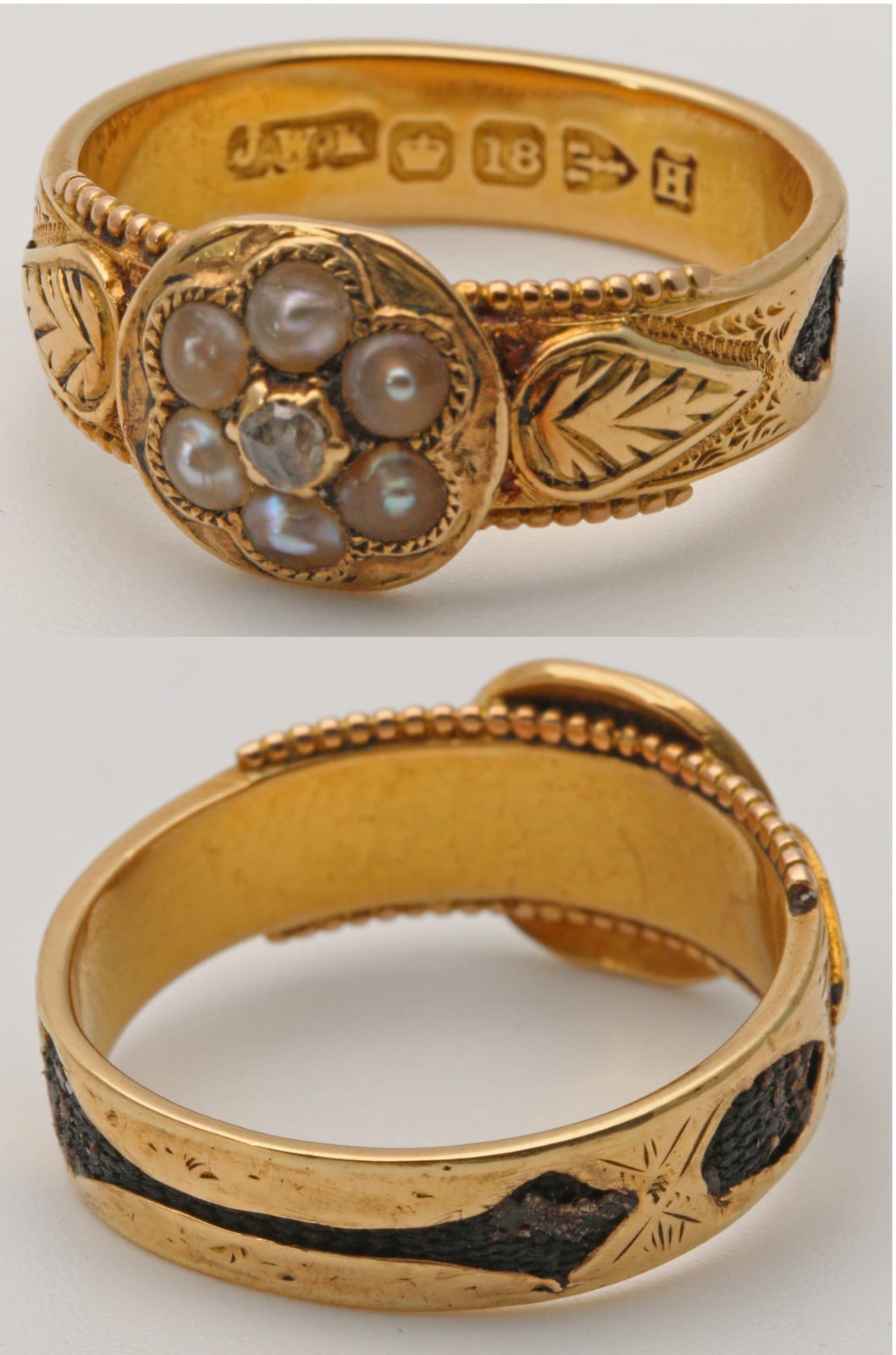
18 stamped inside a gold mourning ring, between a crown and the Chester assay office mark (1891)Photo: Charles J. Sharp, CC BY-SA 4.0, via Wikimedia Commons

Read next
- Next in Jewelry marks22K gold (916)The metal is 22-karat gold: 22 parts in 24 are pure gold, 916.6 in every 1,000.
- The same shape in AI labels and iconsAI iconAI-generated or AI-changed content. A badge with the letters AI, often in a circle or beside a word such as generated or modified, labels an image, video, sound or text as made or altered with artificial intelligence. The European Union publishes an official set of these icons.
More jewelry marks
The same shape elsewhere
Browse symbols drawn with circles or letters and numbers.
Sources
- Hallmarking Act 1973, Schedule 1, Hallmarking Act 1973 (c. 43), Sch. 1, Pt. III, legislation.gov.uk (The National Archives), Sch. 1, Pt. III, para. 2
- Hallmarking Act 1973, Schedule 2: Approved Hallmarks, Hallmarking Act 1973 (c. 43), Sch. 2, legislation.gov.uk (The National Archives), Sch. 2, Pt. I, paras. 2 and 3; Pt. 2, para. 13
- Hall Marks on Gold & Silver Plate (Chaffers, 1922), William Chaffers, Hall Marks on Gold & Silver Plate, 1922 edition, Internet Archive (scan), Table of statutes, 1477 and 1573; Statutes, 1798; Reduced standards, 1854; Duty mark; Scotland, 1836
- Hallmarking Act 1973, section 4, Hallmarking Act 1973 (c. 43), s. 4, legislation.gov.uk (The National Archives), s. 4(3)(b)–(c)
- Guides for the Jewelry, Precious Metals, and Pewter Industries (16 CFR Part 23), 16 CFR Part 23 (1 January 2021 edition), Federal Trade Commission, published by the U.S. Government Publishing Office, § 23.3(c)(1); § 23.3(d) n. 32; § 23.7; Appendix (a)
- Falsely Stamped Gold or Silver or Goods Manufactured Therefrom (15 U.S.C. chapter 8), 15 U.S.C. 291–300, the National Gold and Silver Stamping Act (2021 edition), U.S. Government Publishing Office, § 295
- Buying Platinum, Gold, and Silver Jewelry (FTC Consumer Advice), Buying Platinum, Gold, and Silver Jewelry, November 2024, Federal Trade Commission, Gold Jewelry
- How is the Convention working? (Hallmarking Convention), About: how is the Convention working?, Convention on the Control and Marking of Articles of Precious Metals, Standards of fineness
- What is a Hallmark? (Goldsmiths’ Company Assay Office), What is a Hallmark?, The Goldsmiths’ Company Assay Office, London, The Convention Mark; What is a Hallmark?
- A Detailed History of Sheffield Assay Office, A Detailed History of Sheffield Assay Office, Sheffield Assay Office, 1999
- Hallmarking Guidance Notes (UK Assay Offices, 2022), Hallmarking Guidance Notes: practical guidance in relation to the Hallmarking Act 1973, November 2022, The UK Assay Offices, published by the British Hallmarking Council on GOV.UK, p. 3
Researched, edited and approved by Rory Hansen before publishing. Last reviewed September 29, 2026. How we research
Added . Last updated .