Lion passant (sterling silver hallmark)
The mark for sterling silver in a British hallmark: a lion walking, one forepaw raised.
Easily confused with
- Leopard’s head (London hallmark)The mark of the London assay office: the piece was tested and hallmarked in London.
- EPNS (electroplated nickel silver)Electroplated nickel silver: a base of nickel silver, an alloy of copper, nickel and zinc, coated with a thin layer of silver by electroplating. It is not solid silver.
How to read it
Under the UK’s Hallmarking Act, the optional picture mark for 925 silver is a lion passant; on silver hallmarked at Edinburgh it is a lion rampant, standing on its hind legs, instead. The Act also allows the lion passant, as an alternative to Britannia, on silver of 958.4 and 999. Chaffers dates the earliest lion passant found on plate to 1545, and until 1999 it was a compulsory part of a hallmark on English sterling silver; Sheffield Assay Office records that the sterling lion became optional in January 1999, and that all goods are now marked with their standard of fineness in parts per thousand.
Also searched as: lion hallmark, lion passant hallmark, walking lion hallmark.
A stamp is a claim about the metal, made by whoever struck it. This page says what each mark means under the rules that define it; it doesn’t test or value anything.
A lion or a leopard?
Jackson points out that the proper heraldic name of the animal is leopard, the same beast whose head is the London mark. The Silver Society describes the mark as a lion walking across the field of view, with three paws on the ground and the right forepaw raised.
When the lion first appeared
The sources differ by a year. The Silver Society says the lion passant was introduced in 1544, under Henry VIII. Chaffers had not seen it before plate of 1545: his earliest example is the silver-gilt rose water dish and ewer at Corpus Christi College, Cambridge, with London marks for 1545–6. He adds that the first mention of the mark in the Goldsmiths’ Company’s records is in May 1597, where it is called Her Majesty’s Lion.
Facing you or facing ahead
Older lions turn their heads to look out of the mark (passant guardant). The Silver Society says the London lion faced the viewer until 1821 and after that faced the way it was walking. Chaffers dates the change to 1916, when a new cycle of date letters began. The difference matters when the lion is used to date a piece, and tables of marks show both forms.
On sterling silver across England
Other marks varied from office to office, but the Silver Society notes that after 1720 the lion passant was used by all the English assay offices, so the same lion was on every piece of English sterling. It was not used from 1697 to 1720, when the higher Britannia standard replaced it with a seated figure of Britannia. Scotland and Ireland used other standard marks: a thistle at Edinburgh, a lion rampant at Glasgow and a crowned harp at Dublin.
On gold as well
Chaffers describes the lion passant as the standard mark for standard gold as well as sterling silver from 1545. That ended for 18-carat gold in 1798, when a crown and 18 replaced it, and for 22-carat gold in 1844, when a crown and 22 did. The crown is still the gold picture mark.
Lion passant, lion rampant and lion’s head erased
Three lion marks are easy to confuse. The lion passant walks on three paws. The lion rampant, struck at Edinburgh in place of the lion passant, stands on its hind legs. The lion’s head erased, a head with a jagged neckline, marked Britannia silver from 1697. The town mark beside them names the assay office.
Lions on plated wares and pewter
The Silver Society notes that makers of silver-plated wares often applied marks that simulated hallmarks, sometimes their name and spurious symbols set in shields to look genuine, and that pewterers often struck imitation silver marks on their work.
How the lion’s outline changed
The outline around the lion is another dating clue, and Chaffers lists the London forms. The lion was crowned from 1545 to 1548, then uncrowned in a rectangle; from 1558 to 1678 it sat in an irregular outline, then in an arched one until 1697. After sterling returned, it was in a rectangle from 1720 to 1739, in a regular shield from 1756 to 1896, and from 1896 to 1916 in a shield with three lobes above and three below.
Real examples
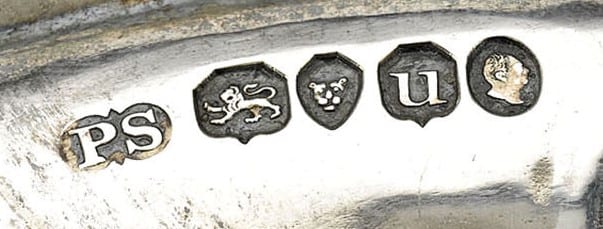
Lion passant second in a row of London marks on a silver tray by Paul Storr, 1835Photo: Rauantiques, CC BY-SA 4.0, via Wikimedia Commons 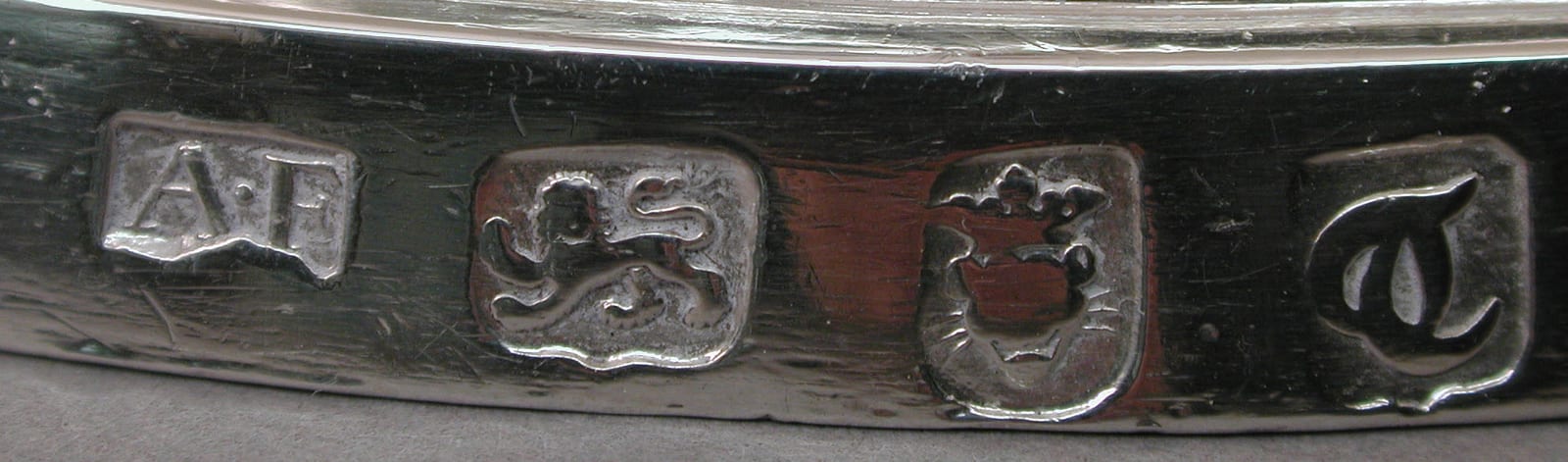
Lion passant beside the maker's mark AF and a crowned leopard's head on a silver candlestick by Andrew FogelbergPhoto: The Metropolitan Museum of Art, CC0, via Wikimedia Commons 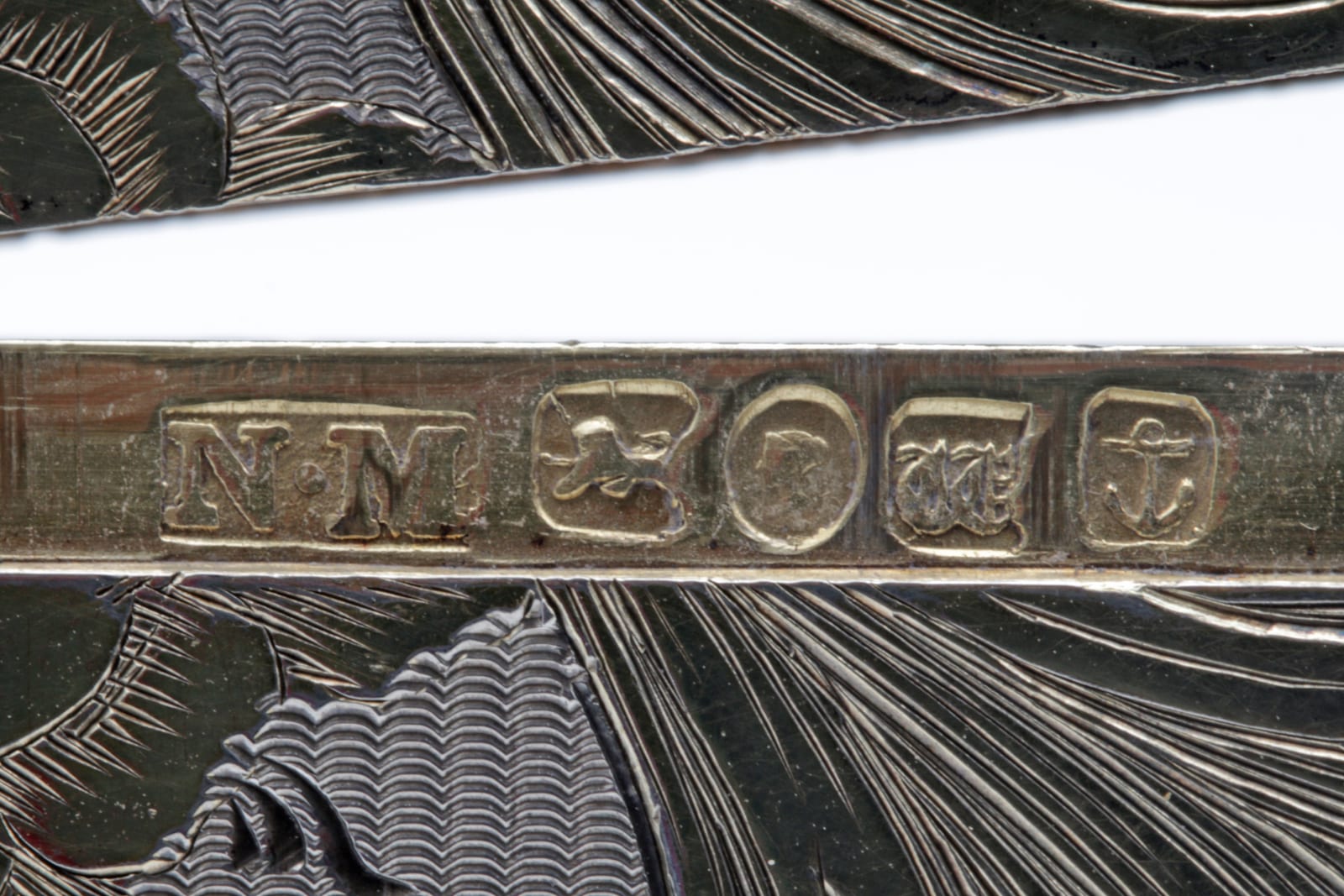
Lion passant between the maker's mark NM and the sovereign's head, on silver by Nathaniel Mills, Birmingham 1845Photo: Charles J. Sharp, CC BY-SA 4.0, via Wikimedia Commons 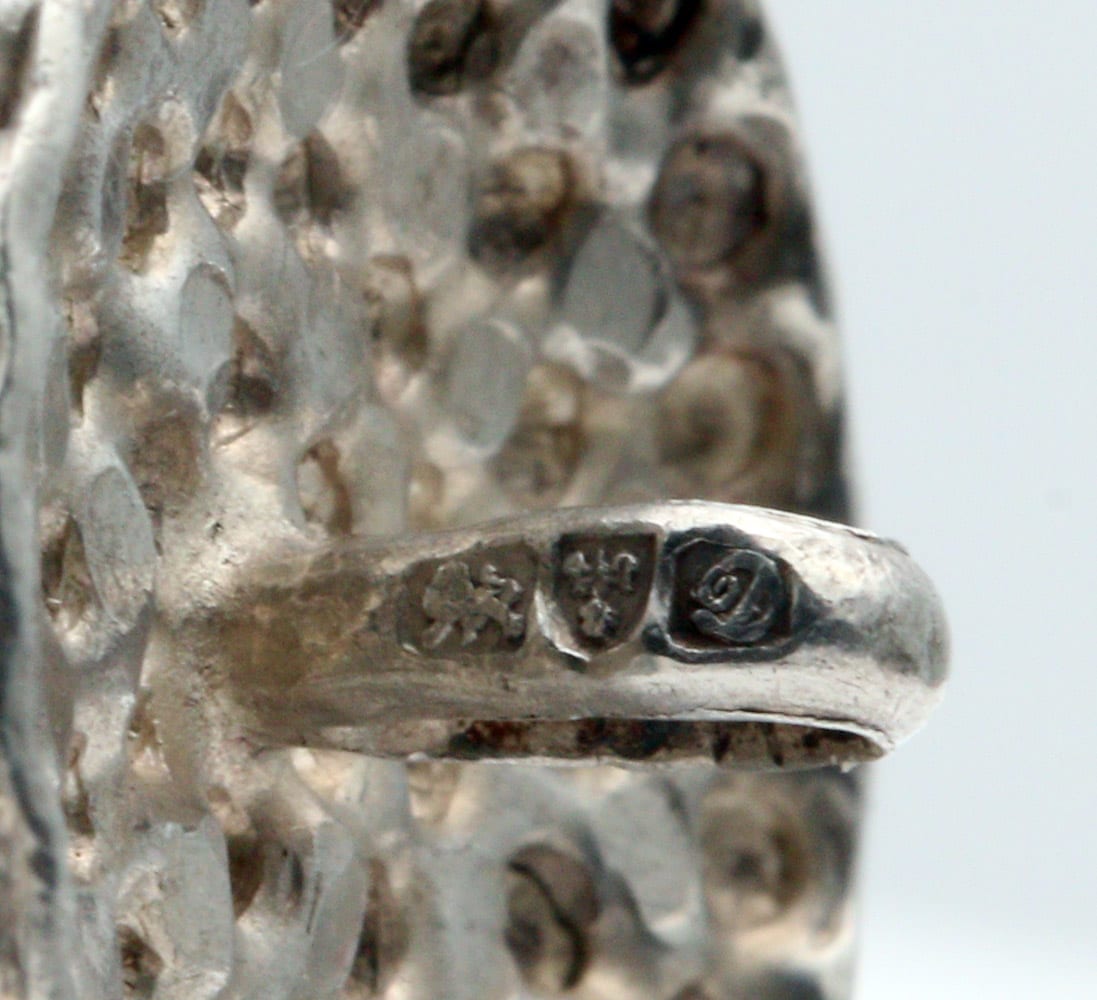
Lion passant with the Chester mark and date letter on a silver button by Charles Horner, 1904Photo: Charles J. Sharp, CC BY-SA 4.0, via Wikimedia Commons


Read next
- Next in Jewelry marksAnchor (Birmingham hallmark)The mark of the Birmingham assay office: the piece was tested and hallmarked in Birmingham.
- The same shape in Power and device symbolsHeadphone jack symbolHeadphones. A pair of headphones marks the socket for headphones, or shows on a phone’s screen that headphones are connected.
More jewelry marks
The same shape elsewhere
Browse symbols drawn with curves and waves.
Sources
- Hallmarking Act 1973, Schedule 2: Approved Hallmarks, Hallmarking Act 1973 (c. 43), Sch. 2, legislation.gov.uk (The National Archives), Sch. 2, Pt. I, para. 3
- Hall Marks on Gold & Silver Plate (Chaffers, 1922), William Chaffers, Hall Marks on Gold & Silver Plate, 1922 edition, Internet Archive (scan), The standard mark; Statutes, 1798 and 1844; The standard mark
- English Goldsmiths and Their Marks (Jackson, 1905), Charles James Jackson, English Goldsmiths and Their Marks, 1905, Internet Archive (Cornell University Library scan), The lion passant, 1544
- Identify Your Silver (The Silver Society), Identify Your Silver: an introduction to British hallmarks, The Silver Society, Standard mark
- A Detailed History of Sheffield Assay Office, A Detailed History of Sheffield Assay Office, Sheffield Assay Office, 1999
Researched, edited and approved by Rory Hansen before publishing. Last reviewed September 29, 2026. How we research
Added . Last updated .