Leopard’s head (London hallmark)
The mark of the London assay office: the piece was tested and hallmarked in London.
Easily confused with
How to read it
The UK’s Hallmarking Act gives each assay office its own mark, and London’s is a leopard’s head. It is also the oldest: Chaffers and Jackson both trace it to a statute of 1300, under which silver was to be marked with a leopard’s head by the wardens of the craft. The Goldsmiths’ Company, which runs the London office, dates the beginning of hallmarking in Britain to that statute of Edward I, and says the head was supposedly taken from the royal arms and later known as the King’s mark. Today it is struck beside the sponsor’s mark and the fineness mark.
Also searched as: leopard’s head hallmark, London assay office mark, London hallmark.
A stamp is a claim about the metal, made by whoever struck it. This page says what each mark means under the rules that define it; it doesn’t test or value anything.
The leopard’s head and the lion
The lion passant is a different mark, for sterling silver rather than for London. Jackson notes that heraldically the lion passant is a leopard too, while the London mark keeps the name leopard’s head. The sources explain the name differently. Jackson quotes a Mr Morgan: in the Old French of the early statutes, leopart was the heraldic word for a lion passant guardant, so the leopard’s head is properly a lion’s head seen full face. The Silver Society calls it a mistranslation of the Norman-French Act that has stuck. Chaffers records old names for the punch, including the Liberd Heed and the Catte’s Face.
A standard mark or a town mark?
Today it is London’s assay office mark, and the Goldsmiths’ Company Assay Office calls it the town mark for London. Historically it was more than that. The Silver Society points out that London had no separate town mark: the leopard’s head was a standard mark, and after 1720 the assay offices of Chester, Exeter, Newcastle and York struck it on sterling silver too, beside their own town marks, until each stopped, Exeter in 1778 and Newcastle not until it closed in 1884. Birmingham and Sheffield, authorised in 1773, did not strike it.
Crowned or uncrowned
A crown on the head is one of the ways old London silver is dated. The Silver Society says the head was uncrowned at first and a crown was added in 1478, when the law was made stricter; Jackson agrees that no crowned example has been found from before the date letter began. The sources differ on when the crown came off. Jackson and the Silver Society give 1821. Chaffers gives 1822 in his chapter on the mark, when the head also lost its mane and beard, and 1823 in his introduction.
Missing on Britannia silver
From 1697 to 1720, the years of the higher Britannia standard, Chaffers records that the lion’s head erased was used instead of the leopard’s head. A London piece of those years has a lion’s head with a jagged neck and a seated Britannia in place of the leopard’s head and lion passant.
In the Goldsmiths’ Company’s arms
The Goldsmiths’ Company’s own coat of arms shows leopards’ heads, which the Company describes as an obvious allusion to the king’s mark of 1300.
Other assay office marks
The Hallmarking Act gives the other three offices an anchor (Birmingham), a rose (Sheffield) and a castle (Edinburgh). A modern London hallmark has three compulsory marks: the sponsor’s mark, the millesimal fineness mark and the leopard’s head. The Goldsmiths’ Company Assay Office also strikes a traditional fineness symbol and a date letter as standard, though both are optional in law.
How the head changed shape
Chaffers traces the mark through its shapes. It was already of ancient use, he says, when the Goldsmiths’ Company’s charter of 1327 mentioned the puncheon. The head was placed in a circle for the last time in 1678; from 1739 its shield took a shape like the date letter’s; after 1763 it was made smaller, in a plain shield; and a new form was adopted in 1896. He was scathing about the uncrowned, maneless head of the 1820s, which he said looked more like a half-starved cat than a lion.
Real examples
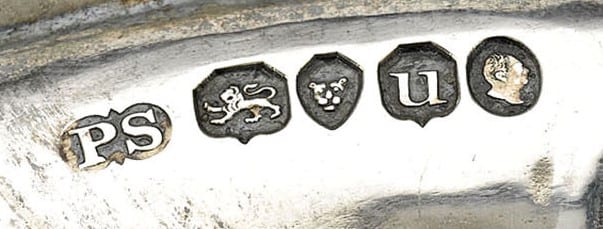
Uncrowned leopard's head (London) in a row of marks on a silver tray by Paul Storr, 1835Photo: Rauantiques, CC BY-SA 4.0, via Wikimedia Commons 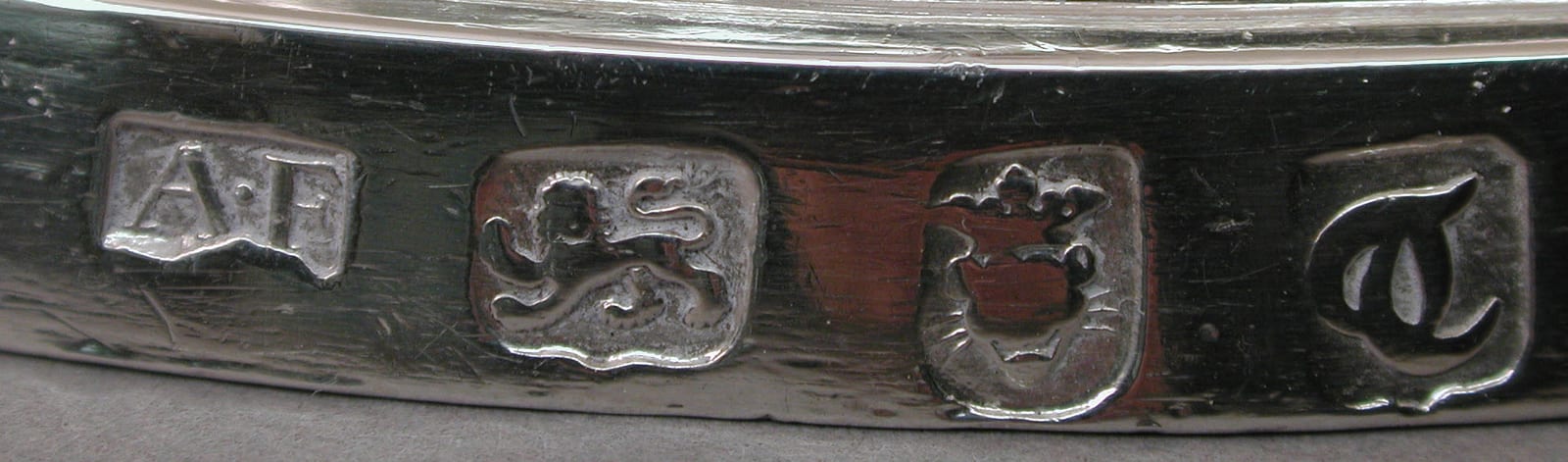
Crowned leopard's head (London) beside a lion passant on an 18th-century silver candlestick by Andrew FogelbergPhoto: The Metropolitan Museum of Art, CC0, via Wikimedia Commons


Read next
- Next in Jewelry marksLion passant (sterling silver hallmark)The mark for sterling silver in a British hallmark: a lion walking, one forepaw raised.
- The same shape in P&ID symbolsField-mounted instrumentAn instrument mounted in the plant, out where the process is. It is drawn as a plain circle, the “bubble”, with the instrument’s tag inside.
More jewelry marks
The same shape elsewhere
Browse symbols drawn with circles.
Sources
- Hallmarking Act 1973, Schedule 2: Approved Hallmarks, Hallmarking Act 1973 (c. 43), Sch. 2, legislation.gov.uk (The National Archives), Sch. 2, Pt. I, para. 1
- Hall Marks on Gold & Silver Plate (Chaffers, 1922), William Chaffers, Hall Marks on Gold & Silver Plate, 1922 edition, Internet Archive (scan), Statute of 1300; The leopard’s head; Introduction; The leopard’s head
- English Goldsmiths and Their Marks (Jackson, 1905), Charles James Jackson, English Goldsmiths and Their Marks, 1905, Internet Archive (Cornell University Library scan), Statute of 1300; The leopard’s head
- The Goldsmiths’ Company: history, History of the Goldsmiths’ Company, The Goldsmiths’ Company, 1300; 1571
- Identify Your Silver (The Silver Society), Identify Your Silver: an introduction to British hallmarks, The Silver Society, Standard mark; Town mark
- What is a Hallmark? (Goldsmiths’ Company Assay Office), What is a Hallmark?, The Goldsmiths’ Company Assay Office, London, Assay Office Mark; Hallmark
Researched, edited and approved by Rory Hansen before publishing. Last reviewed September 29, 2026. How we research
Added . Last updated .