Crown (gold hallmark)
The picture mark for gold in a British hallmark.
Easily confused with
How to read it
Under the UK’s Hallmarking Act, the optional picture mark for every gold standard, from 375 to 999, is a crown, struck beside the figures for the standard. Chaffers records its start: a 1798 statute had 18-carat gold marked with a crown and the figures 18, instead of the lion passant. Since January 1999 the crown has been optional: Sheffield Assay Office records that the crown gold mark and the sterling lion both became optional then, and the 1998 amendment regulations make a picture mark something an assay office strikes only when asked.
Also searched as: crown hallmark, crown mark on gold.
A stamp is a claim about the metal, made by whoever struck it. This page says what each mark means under the rules that define it; it doesn’t test or value anything.
Not the Sheffield crown
Older Sheffield silver can carry a crown as the Sheffield assay office’s mark; on gold, the crown stands for the metal. Sheffield Assay Office says its crown was the town mark for silver from 1773, and that it gave it up for the rose after the 1973 Act.
A crown with 18, a crown with 22
The crown began as part of a pair. From 1798, 18-carat gold was marked with a crown and the figures 18, and from October 1844, Chaffers records, 22-carat gold was marked with a crown and the figure 22, both instead of the lion passant.
Why lower-carat gold of the 1800s has no crown
When 15, 12 and 9 carat gold were allowed in 1854, they were marked with their carat figure and a decimal: 15 and .625, 12 and .5, 9 and .375. Chaffers writes that both the crown and the duty mark of the sovereign’s head were omitted on these three lower standards, and quotes evidence to a Parliamentary Commission that Birmingham makers had hoped to put the crown on them. Today the Act gives the crown to all six gold standards, 375 included.
A crown or a crowned head?
Two other old marks carry crowns. The leopard’s head of London was crowned from 1478 until the 1820s, and the lion passant was crowned for its first few years. In both, the crown sits on an animal’s head; the gold mark is a crown on its own.
Picture marks for the other metals
The Act gives each precious metal its own optional picture mark: the crown for gold, the lion passant (or lion rampant at Edinburgh) for sterling silver, Britannia or the lion for 958.4 and 999 silver, an orb surmounted by a cross for 950 and 999 platinum, and the head of Pallas Athene for palladium.
The crown is not the Convention mark
Gold marked under the International Hallmarking Convention carries the Common Control Mark instead, which the British Hallmarking Council describes as a pair of scales around the fineness figure. The crown is a UK mark, and the millesimal figure beside it is what states the gold’s fineness.
No crown on Scottish gold
The crown was an English mark. Chaffers’s list of the marks required in Scotland in his day gives standard gold five marks: the quality in karats (22 or 18), the thistle for Edinburgh or the lion rampant for Glasgow, the mark of the assay town, the date letter and the maker’s mark. There is no crown in it.
No crown on gold-plated silver
A crown and a gold fineness figure are marks for solid gold. The UK assay offices hallmark gold-plated silver as silver, and their guidance notes say no standalone gold fineness mark is allowed on it. Gold articles under 1 gram are exempt from hallmarking, so a small gold piece may carry no marks at all.
Real examples
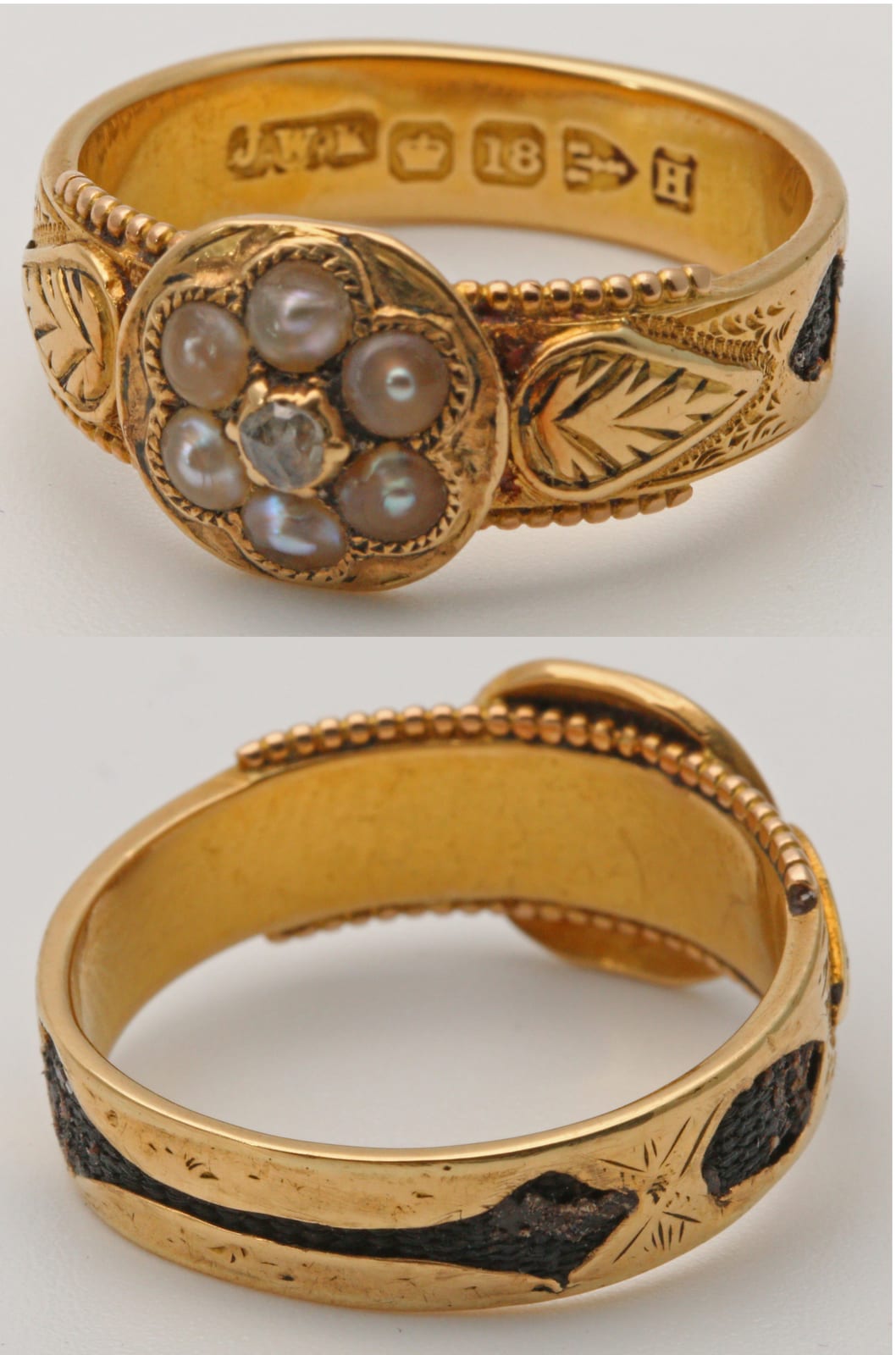
A crown stamped inside a gold ring, next to 18 and the Chester assay office mark (1891)Photo: Charles J. Sharp, CC BY-SA 4.0, via Wikimedia Commons

Read next
- Next in Jewelry marksDate letter (hallmark)A letter in a British hallmark that shows the year the piece was marked.
- The same shape in African flagsFlag of the ComorosThe Comoros flag is four horizontal stripes, yellow, white, red and blue from the top, with a green triangle along the pole holding a white crescent and four white stars in a line between its tips. Norway’s Store norske leksikon explains the crescent as the symbol of Islam and the four stars as the four islands of the Comoros; Lex says the four stripes are said to stand for the islands too.
More jewelry marks
The same shape elsewhere
Browse symbols drawn with triangles.
Sources
- Hallmarking Act 1973, Schedule 2: Approved Hallmarks, Hallmarking Act 1973 (c. 43), Sch. 2, legislation.gov.uk (The National Archives), Sch. 2, Pt. I, para. 3
- Hall Marks on Gold & Silver Plate (Chaffers, 1922), William Chaffers, Hall Marks on Gold & Silver Plate, 1922 edition, Internet Archive (scan), Statutes, 1798; 1844; 1854; Duty mark; Marks required in Scotland
- A Detailed History of Sheffield Assay Office, A Detailed History of Sheffield Assay Office, Sheffield Assay Office, Crown town mark; 1999
- The Hallmarking (Hallmarking Act Amendment) Regulations 1998, S.I. 1998/2978, as made, legislation.gov.uk (The National Archives), reg. 2(8)
- Identify Your Silver (The Silver Society), Identify Your Silver: an introduction to British hallmarks, The Silver Society, Standard mark
- Hallmarking is the law: guidance summary (British Hallmarking Council), Hallmarking: practical guidance, summary, British Hallmarking Council, GOV.UK, Convention marks
- Hallmarking Guidance Notes (UK Assay Offices, 2022), Hallmarking Guidance Notes: practical guidance in relation to the Hallmarking Act 1973, November 2022, The UK Assay Offices, published by the British Hallmarking Council on GOV.UK, pp. 2, 11
Researched, edited and approved by Rory Hansen before publishing. Last reviewed September 30, 2026. How we research
Added . Last updated .