Anchor (Birmingham hallmark)
The mark of the Birmingham assay office: the piece was tested and hallmarked in Birmingham.
How to read it
The UK’s Hallmarking Act lists an anchor as the mark of the Birmingham assay office, and Chaffers’s 1922 list of assay office marks gives the same. Birmingham Assay Office was founded in 1773, by the same Act of Parliament that set up the Sheffield office. It was empowered to hallmark gold in 1824, and Jackson notes that gold assayed at Birmingham has carried the same marks as London gold, except that the anchor takes the place of the leopard’s head.
Also searched as: anchor hallmark, Birmingham assay office mark.
A stamp is a claim about the metal, made by whoever struck it. This page says what each mark means under the rules that define it; it doesn’t test or value anything.
Why an anchor?
Nobody can say for certain. Sheffield Assay Office tells the story that the Birmingham and Sheffield petitioners for the 1773 Act met at the Crown and Anchor, an inn off the Strand in London, and that each town adopted one of its signs as its mark. It adds that the inn certainly existed, but whether there is any truth in the story is unknown. The Silver Society describes the mark as a ship’s anchor.
The anchor and the leopard’s head
Birmingham did not strike the leopard’s head. The Silver Society notes that the provincial English offices at Chester, Exeter, Newcastle and York struck the leopard’s head beside their own town marks after 1720, but that the Birmingham and Sheffield offices, authorised in 1773, did not. An anchor alone marks Birmingham.
The anchor with a compass
Since 1 April 2019 a second Birmingham mark has been in use. The British Hallmarking Council describes it as a vertical anchor and a compass within a cut-cornered rectangular outline, and says it is the only assay office mark used on articles marked at Birmingham Assay Office’s sub-office in Mumbai. The Council decided in March 2018 that UK offices hallmarking outside the UK should use a differentiated mark, and added it to the Dealer’s Notice that UK sellers of precious metal must display.
Special Birmingham marks
Birmingham Assay Office’s timeline records a bicentenary mark in 1973: the letter c either side of the anchor. Sheffield marked the same anniversary by using its 1773 date letter, E, again.
The anchor and where a piece was made
The anchor says where a piece was tested and marked, not where it was made; the Silver Society notes that the assay office where an item was hallmarked may not be where it was actually made. Since the 1973 Act came in, Birmingham has used the same date letters as the other offices, changing on 1 January.
Birmingham and the duty years
Birmingham’s timeline also dates the introduction of duty on silver and gold, and the King’s head duty mark, to 1784, and its removal to 1890. The 1854 lower gold standards of 15, 12 and 9 carat, and the 1932 change from 15 and 12 carat to 14, are on the same timeline.
What the 1773 Act said
The anchor is written into the founding statute. Chaffers quotes the Act of 13 George III, chapter 52: the peculiar marks of the two new companies were to be, for the Birmingham Company, an Anchor, and for the Sheffield Company, a Crown. Silver was to carry the maker’s initials, the lion passant, the company’s mark and a letter changed each year on the election of new wardens. Chaffers writes that before then Birmingham silversmiths sent their wares to London and Chester to be assayed, and that the Birmingham plateworkers petitioned the House of Commons in February 1773.
Birmingham’s reach and its letters
Under the 1773 Act, Chaffers writes, the Birmingham and Sheffield offices could assay and mark plate made within twenty miles of their towns; an Act of 1854 let any maker register a mark at whichever office they chose. Before 1975 Birmingham’s letter was changed with the annual election of wardens, and the custom was to take the letters in alphabetical order. The Birmingham lion passant he illustrates is not guardant.
Real examples
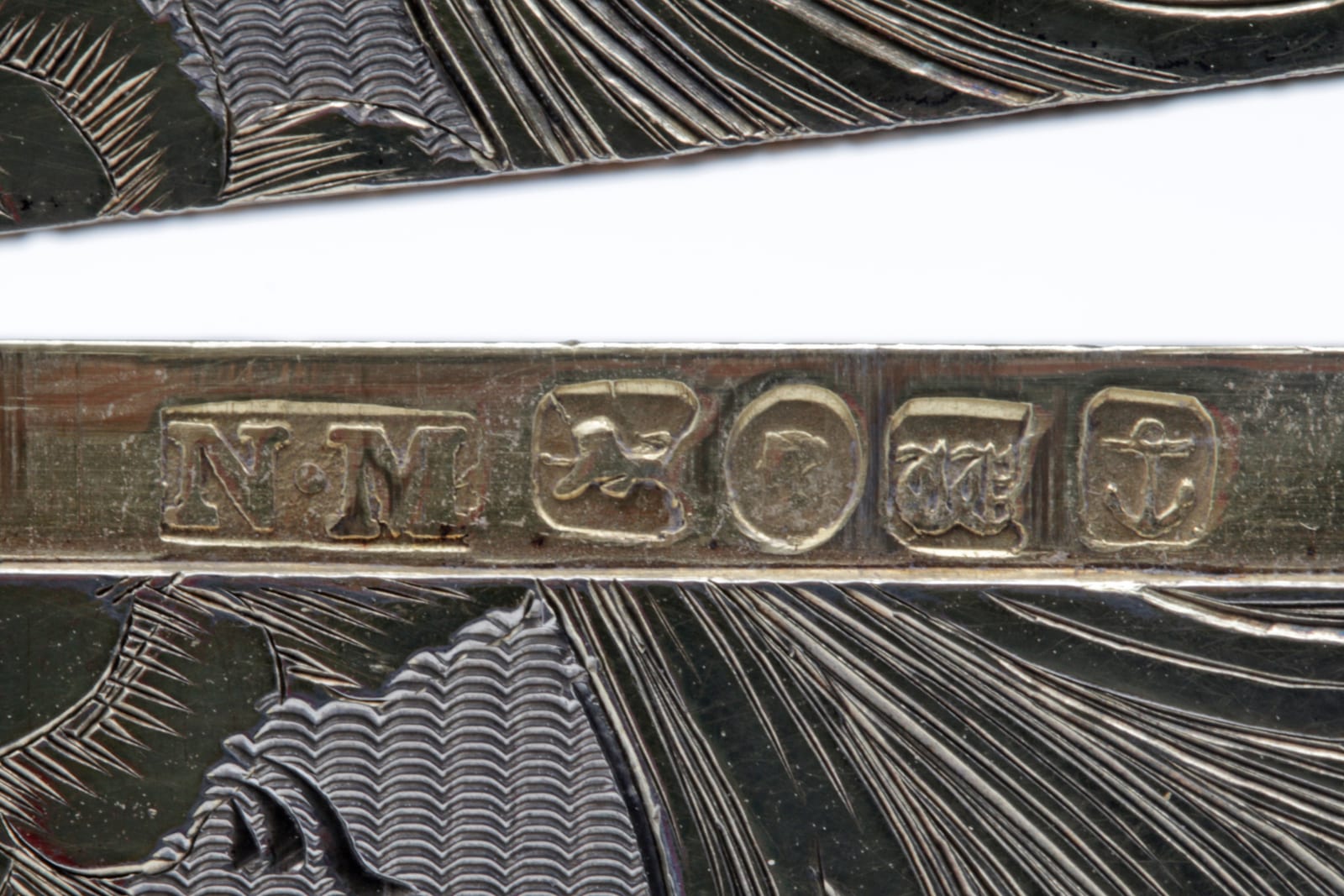
Anchor at the end of a row of hallmarks on silver by Nathaniel Mills, Birmingham 1845Photo: Charles J. Sharp, CC BY-SA 4.0, via Wikimedia Commons 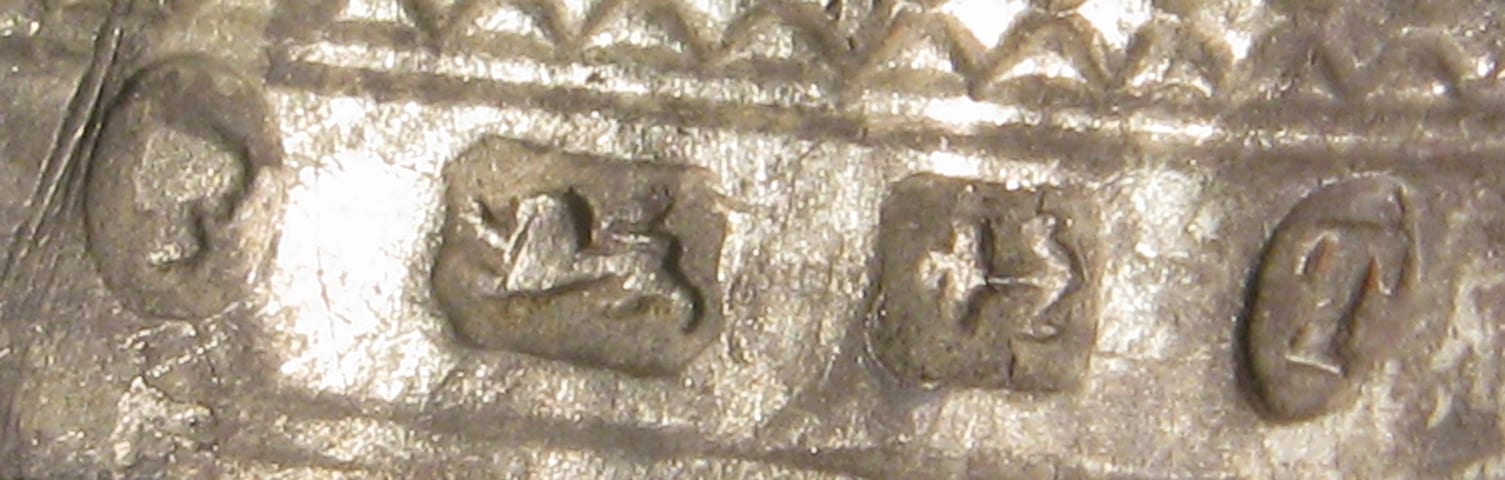
Lion passant, anchor and date letter T stamped on a silver thimble, Birmingham 1868Photo: Birmingham Museums Trust, Teresa Gilmore (Portable Antiquities Scheme), CC BY-SA 2.0, via Wikimedia Commons 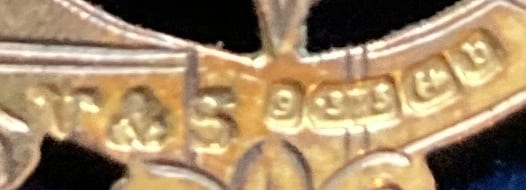
Maker's mark V&S, 9 and .375 for 9-carat gold, an anchor and date letter b on a medal, Birmingham 1901Photo: Lloyd Davis from London, UK, CC BY-SA 2.0, via Wikimedia Commons


Read next
More jewelry marks
The same shape elsewhere
Browse symbols drawn with crosses or curves and waves.
Sources
- Hallmarking Act 1973, Schedule 2: Approved Hallmarks, Hallmarking Act 1973 (c. 43), Sch. 2, legislation.gov.uk (The National Archives), Sch. 2, Pt. I, para. 1
- Hall Marks on Gold & Silver Plate (Chaffers, 1922), William Chaffers, Hall Marks on Gold & Silver Plate, 1922 edition, Internet Archive (scan), Assay office marks; Table of statutes, 1773; Birmingham
- English Goldsmiths and Their Marks (Jackson, 1905), Charles James Jackson, English Goldsmiths and Their Marks, 1905, Internet Archive (Cornell University Library scan), Marks on Birmingham gold
- Our Story (Birmingham Assay Office), Our Story: timeline, 1773–2009, Birmingham Assay Office, Timeline, 1773–1975
- A Detailed History of Sheffield Assay Office, A Detailed History of Sheffield Assay Office, Sheffield Assay Office, Crown and Anchor
- Identify Your Silver (The Silver Society), Identify Your Silver: an introduction to British hallmarks, The Silver Society, Town mark
- New Hallmarking Dealer’s Notice to be introduced (British Hallmarking Council), News story: New Hallmarking Dealer’s Notice to be introduced, British Hallmarking Council, GOV.UK, The Dealer’s Notice update
Researched, edited and approved by Rory Hansen before publishing. Last reviewed September 30, 2026. How we research
Added . Last updated .