22K gold (916)
The metal is 22-karat gold: 22 parts in 24 are pure gold, 916.6 in every 1,000.
How to read it
The UK’s Hallmarking Act says 22 carats indicates gold of 916·6 parts per thousand, and its hallmark strikes the figures 916 for that standard. It sits below 990 and 999 in the Act’s list of gold standards, and carries the same optional crown as the other gold standards. In the US, the FTC’s jewelry guides allow any gold alloy to be marked with a correct karat figure, and the Stamping Act lets the gold fall short of the marked fineness by no more than three parts per thousand.
Also searched as: 22K, 22 karat, 916.
A stamp is a claim about the metal, made by whoever struck it. This page says what each mark means under the rules that define it; it doesn’t test or value anything.
22 or 18 in older Scottish marks
Chaffers lists the marks struck on standard gold in Scotland in his day, the first being the quality in karats, 22 or 18. The Scottish Act of 1836 he quotes set the standard gold of Scotland at not less than 22 karats in every pound troy, marked with the thistle, the date letter and the assay office’s own mark, with the figures 18 added for gold of 18 karats.
22 carat in English statutes
Chaffers’s table of statutes records 22 carat revived as the English standard under Elizabeth I in 1573. When 18 carat was legalised in 1798, the statute provided that gold of 22 carats might still be made. From October 1844, English 22-carat gold was to be marked with a crown and the figure 22, instead of the lion passant.
Why 916 and not 917
Twenty-two twenty-fourths is 916.67 parts per thousand. The Act defines the standard as 916·6 and strikes the figures 916, so the hallmark rounds down. The assay offices’ guidance notes say the fineness mark means the metal is not less than the fineness indicated.
Solder in a 22-carat piece
The Act lets solder in gold of 916·6 be of a fineness not less than 750, lower than the article itself. The assay offices’ table gives the same figure. Solder below the article’s standard may be used only for joining parts.
916 under the Hallmarking Convention
916 is one of the gold finenesses recognised under the Convention, but not one of the five the Convention says are legal in every member state (Pt 950, Au 750, Au 585, Ag 925 and Ag 800). The Convention adds that members accept marked articles only in a fineness that is legal in the importing country.
22ct gold vermeil and gold clad
A 22ct figure can describe a plating rather than the piece. The UK assay offices’ guidance lists 22ct gold clad ring and 22ct gold vermeil ring as misleading descriptions of gold-plated silver: in the UK such a piece has to be described as silver, with gold directly followed by plated. On a hallmarked 22-carat article, the fineness figure 916 is struck in the gold shield.
The old coin standard
22 carat was the standard of English gold coin as well as plate. Chaffers prints a record from 1649 of the trial pieces made for the coinage: gold of 22 carats of fine gold and 2 carats of alloy in the pound troy, and silver of 11 ounces 2 pennyweights fine, which is sterling.
Old gold wedding rings
Birmingham Assay Office’s timeline records the Gold Wedding Ring Act of 1855, which required all wedding rings to be hallmarked. Other gold rings did not have to be. The Hallmarking Act still lists, among the exemptions for gold of minimum fineness made before 1 January 1975, rings other than wedding rings, along with pencil cases, lockets, watch chains and thimbles. So an old gold ring, other than a wedding ring, may have no hallmark.
Real examples
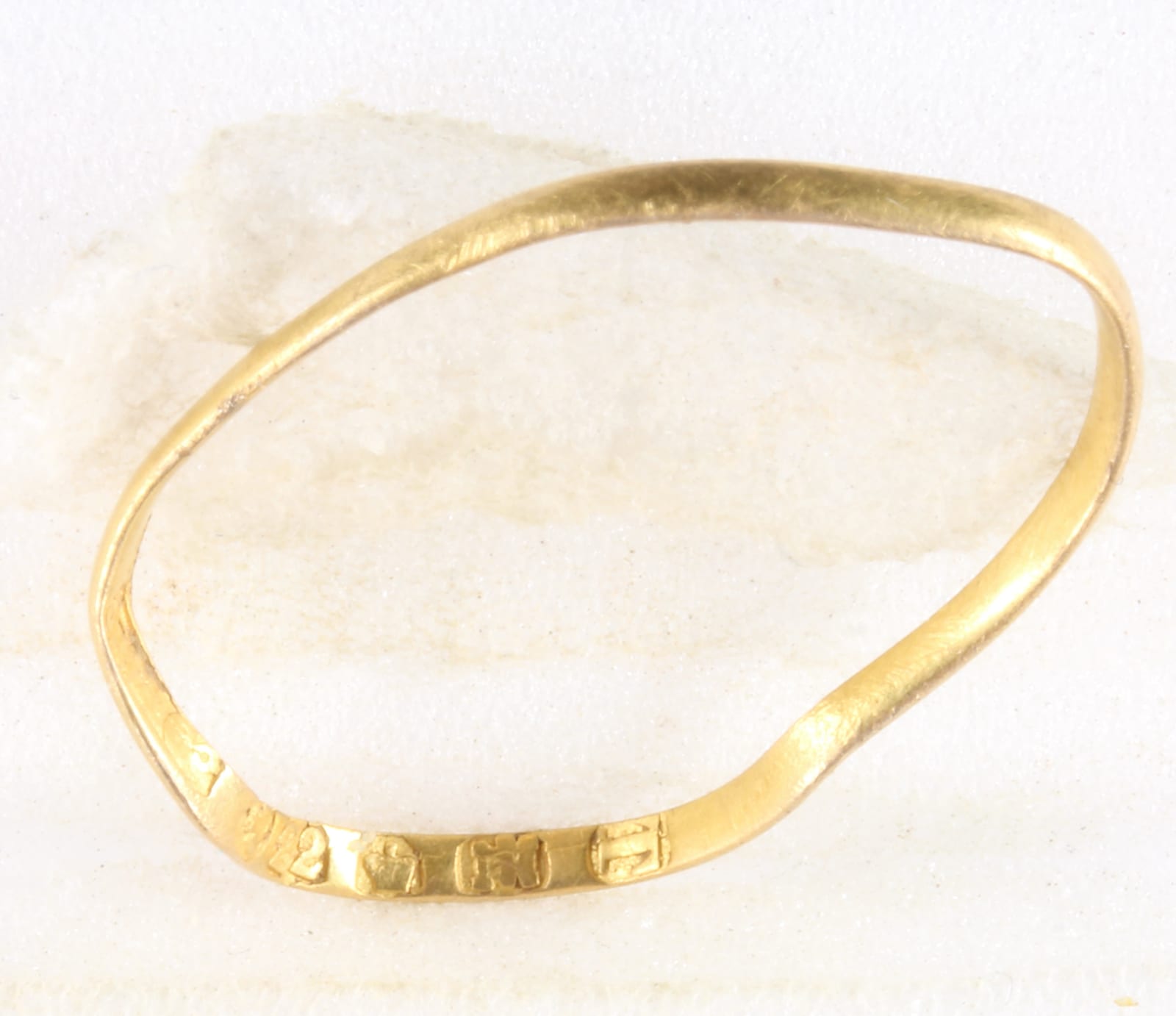
22 stamped inside a thin gold band, followed by more marks from the Exeter assay office (1875)Photo: Somerset County Council, Wil Partridge (Portable Antiquities Scheme), CC BY 2.0, via Wikimedia Commons

Read next
- Next in Jewelry marks24K gold (999)The metal is fine gold: 24 karats, marked 999 under the UK’s hallmarking rules.
- The same shape in AI labels and iconsAI iconAI-generated or AI-changed content. A badge with the letters AI, often in a circle or beside a word such as generated or modified, labels an image, video, sound or text as made or altered with artificial intelligence. The European Union publishes an official set of these icons.
More jewelry marks
The same shape elsewhere
Browse symbols drawn with circles or letters and numbers.
Sources
- Hallmarking Act 1973, Schedule 1, Hallmarking Act 1973 (c. 43), Sch. 1, Pt. III, legislation.gov.uk (The National Archives), Sch. 1, Pt. III, para. 2; Sch. 1, Pt. II, para. 15
- Hallmarking Act 1973, Schedule 2: Approved Hallmarks, Hallmarking Act 1973 (c. 43), Sch. 2, legislation.gov.uk (The National Archives), Sch. 2, Pt. I, paras. 2 and 3
- Hall Marks on Gold & Silver Plate (Chaffers, 1922), William Chaffers, Hall Marks on Gold & Silver Plate, 1922 edition, Internet Archive (scan), Marks required in Scotland; Scotland, 1836; Table of statutes, 1573; Statutes, 1798 and 1844; 1649, trial of the Pyx
- Hallmarking Act 1973, section 4, Hallmarking Act 1973 (c. 43), s. 4, legislation.gov.uk (The National Archives), s. 4(3)(b)(i), (c)
- Hallmarking Guidance Notes (UK Assay Offices, 2022), Hallmarking Guidance Notes: practical guidance in relation to the Hallmarking Act 1973, November 2022, The UK Assay Offices, published by the British Hallmarking Council on GOV.UK, pp. 3, 4, 6, 23
- How is the Convention working? (Hallmarking Convention), About: how is the Convention working?, Convention on the Control and Marking of Articles of Precious Metals, Standards of fineness
- Guides for the Jewelry, Precious Metals, and Pewter Industries (16 CFR Part 23), 16 CFR Part 23 (1 January 2021 edition), Federal Trade Commission, published by the U.S. Government Publishing Office, § 23.3(c)(1)
- Falsely Stamped Gold or Silver or Goods Manufactured Therefrom (15 U.S.C. chapter 8), 15 U.S.C. 291–300, the National Gold and Silver Stamping Act (2021 edition), U.S. Government Publishing Office, § 295
- Our Story (Birmingham Assay Office), Our Story: timeline, 1773–2009, Birmingham Assay Office, 1855
Researched, edited and approved by Rory Hansen before publishing. Last reviewed September 30, 2026. How we research
Added . Last updated .